Thursday, February 14, 2019

Zillow Wants to Flip Your House | Bloomberg

The basic model: "Zillow would buy houses, fix them up, and resell them, earning a fee for providing a simple, fast transaction."
"For decades, selling a house in the U.S. was a low-tech, high-stress affair. You hired an agent, fixed your mind on a number, and decided how much time and money you wanted to spend repainting walls, redoing bathrooms, and making other repairs that had seemed too costly or inconvenient to make for your own benefit. You locked up your pets, lit some scented candles, and opened the door to a parade of strangers. Then you waited for an offer—ideally, more than one—and hoped your agent would be able to deliver the price you needed so you could afford your next abode.

There has long been another way, selling to the kind of investors who post signs under the highway overpass promising cash for ugly houses. Those home “flippers” have an unsavory reputation, partly because they’re seen as pushing lowball offers to those behind on their mortgage payments or otherwise desperate—the newly divorced, the widowed, or the unemployed.

Zillow is part of a new breed of high-tech home flippers, sometimes called “iBuyers,” that also includes Silicon Valley startups and a small group of adventurous real estate brokerages that have instant-offer operations. Armed with Wall Street and Silicon Valley capital and algorithms designed to make granular predictions about home prices, these investors are buying homes on a massive scale, wringing tiny profits out of each flip. That makes them valuable to the Rittenhouses and the thousands of other Phoenix-area homeowners who used them last year. It also makes them potentially scary to real estate agents, big-data skeptics, and anyone who remembers the recent history of innovations in housing finance."
Zillow Wants to Flip Your House | Bloomberg

The Strange Experience of Being Australia’s First Tech Billionaires | NYT

From a wide-ranging Atlassian profile
"Atlassian is a very boring software company. It develops products for software engineers and project managers, with hits like Jira (for software project management and bug tracking) and Fisheye (a revision-control browser). And who could forget Confluence (an enterprise knowledge management system)?

So why are its two founders household names in Australia?

Because Scott Farquhar and Mike Cannon-Brookes, both 39, are the country’s first start-up-to-I.P.O. tech billionaires. And because in the last year, they have started to make noise."
The Strange Experience of Being Australia’s First Tech Billionaires | NYT

Emoji wars: Kim Kardashian West sued for $300 million over the use of popular Kimoji | Washington Post

Stranger than fiction...
"They say a picture is worth 1,000 words.

Emoji of Kim Kardashian West could be worth $300 million, according to a new lawsuit.

A social media developer has sued Kardashian West and her company, Kimsaprincess Inc., over emoji and other images of the reality show celebrity. In a suit filed Tuesday in federal court in Oklahoma City, the developer alleges that he and two others teamed up with Kardashian West to create Kimoji designs and merchandising. Now they’re claiming that Kardashian West ran away with the trademark and never shared the profits."
Emoji wars: Kim Kardashian West sued for $300 million over the use of popular Kimoji | Washington Post

Wednesday, February 13, 2019

How hard is it to have a conversation on Twitter? So hard even the CEO can’t do it. | Recode

Also see Twitter CEO Jack Dorsey: I Suck and the Problem Is the Whole Site | Gizmodo
"Twitter wants to be the place for the most important public conversations online. It still has some serious work to do.

Twitter CEO Jack Dorsey and Recode co-founder Kara Swisher agreed to conduct an interview Tuesday on Twitter, and it had all the makings of a great read: The CEO of one of the most influential and controversial tech platforms in the world taking questions from one of the industry’s most ferocious reporters.

The only problem? No one could follow along."
How hard is it to have a conversation on Twitter? So hard even the CEO can’t do it. | Recode

Apple rumored to launch subscription News at March 25 event, 'AirPods 2' and new iPad mini not expected | AppleInsider

Also see Apple is reportedly planning an all-you-can-read subscription news service and wants to keep half the revenue | CNBC
"The event will be "services focused," the highlight being the debut of a paid Apple News subscription, BuzzFeed News said, citing multiple sources. That plan could be called Apple News Magazines, and grant people access to a variety of magazines and newspapers for $10 per month.

Likely missing from the event will be second-generation AirPods or a fifth-generation iPad mini, the report added. Apple has regularly introduced hardware at March events — earlier today, one questionable story suggested that the AirPods, a new Mini, and more could begin preorders on March 22."
Apple rumored to launch subscription News at March 25 event, 'AirPods 2' and new iPad mini not expected | AppleInsider

Follow the CAPEX: Cloud Table Stakes 2018 Edition | Platformonomics

From another timely Charles Fitzgerald cloud reality check
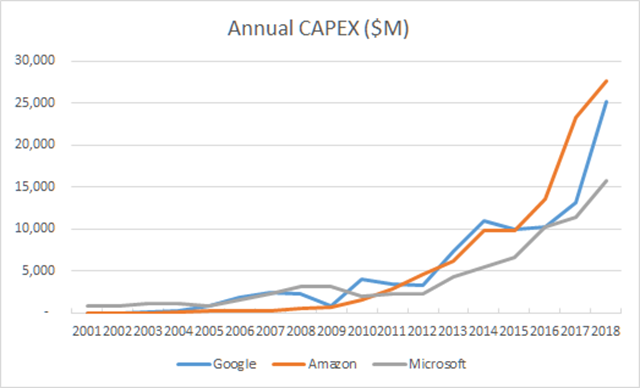
"The three hyper-scale public cloud companies – Amazon, Google, and Microsoft – spent over $68 billion on CAPEX between them in 2018. That is not all for cloud infrastructure (and maybe not even a majority of it), as those companies have other, material CAPEX spend, but it is directionally indicative. All three companies again registered all-time CAPEX highs this year. The combined total is on the order of 5% of total non-residential fixed investment in the US (one wonders whether hand-ringing about relatively disappointing fixed investment across the broader economy is attributable at least in part to the economies of scale of the public clouds)."
Follow the CAPEX: Cloud Table Stakes 2018 Edition | Platformonomics

Tuesday, February 12, 2019

Trump administration unveils order to prioritize and promote AI | Reuters

See this page for the full executive order
"Under the American AI Initiative, the administration is directing agencies to prioritize AI investments in research and development, increase access to federal data and models for that research and prepare workers to adapt to the era of AI.

There was no specific funding announced for the initiative, but the White House wants better reporting and tracking of spending on AI-related research and development.

The White House said investment in AI is “critical to creating the industries of the future, like autonomous cars, industrial robots, algorithms for disease diagnosis, and more.”"
Trump administration unveils order to prioritize and promote AI | Reuters

Apple announces Health Records feature coming to veterans | Apple Newsroom

Later in the post: "Health Records on iPhone will be the first record-sharing platform of its kind available to the VA, which is the largest medical system in the United States providing service to more than 9 million veterans across 1,243 facilities."
"“We have great admiration for veterans, and we’re proud to bring a solution like Health Records on iPhone to the veteran community,” said Tim Cook, Apple’s CEO. “It’s truly an honor to contribute to the improved healthcare of America’s heroes.”
With Health Records on iPhone, veterans across the US will be able to see medical information from participating institutions — including the VA — organized into one view all in the Health app. Health records data includes allergies, conditions, immunizations, lab results, medications, procedures and vitals, and is displayed along with other information in the Health app like Apple Watch data. This means VA patients will get a single, integrated snapshot of their health profile whenever they want quickly and privately. All Health Records data is encrypted and protected with the user’s iPhone passcode, Touch ID or Face ID."
Apple announces Health Records feature coming to veterans | Apple Newsroom

Amazon Gobbles Up Eero to Round Out Its Smart Home Plan | Wired

In case you're inclined to provide Amazon with more personal activity data... For more details, see Amazon to Acquire eero to Help Customers Better Connect Smart Home Devices | Amazon
"But for Amazon, the Eero buy clearly signals how serious the company is about rounding out its smart home hardware offerings—and squeezing as many Amazon-owned access points as it can into a person’s home. In just five years, Amazon has both launched its own array of smart home devices, starting with the first Echo speaker in 2014. The company's roster of smart home devices now includes multiple speakers, TV streaming boxes and sticks, connected television sets, countertop displays, a wall clock, and a DVR, not to mention oddball gadgets like a scanning wand that aids your grocery shopping and a camera that judges your outfits.

Along the way, Amazon also strategically acquired smaller smart home companies, or IoT-adjacent companies. Its 2015 buy of Israeli chipmaker Annapurna Labs seemed to affirm the e-commerce company’s commitment to making its own chips that could power “home gateways, Wi-Fi routers, and network-attached storage devices.” Then, in late 2017, Amazon acquired Blink, a Massachusetts-based startup that made battery-powered smart cameras and smart doorbells. And last year, it spent $1.1 billion on Ring, which also makes smart home products and which Amazon had invested in previously through its Alexa Fund."
Amazon Gobbles Up Eero to Round Out Its Smart Home Plan | Wired

Your Smart Light Can Tell Amazon and Google When You Go to Bed | Bloomberg

The internet of surveillance things
"In other words, after you connect a light fixture to Alexa, Amazon wants to know every time the light is turned on or off, regardless of whether you asked Alexa to toggle the switch. Televisions must report the channel they’re set to. Smart locks must keep the company apprised whether or not the front door bolt is engaged.

This information may seem mundane compared with smartphone geolocation software that follows you around or the trove of personal data Facebook Inc. vacuums up based on your activity. But even gadgets as simple as light bulbs could enable tech companies to fill in blanks about their customers and use the data for marketing purposes. Having already amassed a digital record of activity in public spaces, critics say, tech companies are now bent on establishing a beachhead in the home."
Your Smart Light Can Tell Amazon and Google When You Go to Bed | Bloomberg

Monday, February 11, 2019

Journalism Isn't Dying. It's Returning to Its Roots | Wired

Final paragraphs from a timely journalism reality check; also see We are not being honest with ourselves about the failures of the models we depend upon | Jeff Jarvis
"While the tone of journalism might be headed back to the 19th century, clearly the business models are not. Revenue-wise, the Great 21st Century Journalism Shakeout will likely end with smaller organizations inventing new business models that those villains—the internet and social media—enabled. Technology outlets such as TechCrunch and Recode pioneered expensive (and expensable) conferences. Gimlet Media, just acquired by Spotify for a reported $200 million, produces high-quality journalistic podcasts, pitching them as shows to Netflix and Hollywood, while selling ads. Gear review sites like Wirecutter (which The New York Times acquired in 2016) make substantial revenue via affiliate marketing, taking a cut of sales they drive on ecommerce sites. Books, those antique vestiges of a preinternet age, still command large advances, and audiobook sales at most publishers are growing at a healthy pace. (As a personal anecdote, I have five times the number of reviews on Audible as I do on Amazon: I’m theoretically an author, but I have more listeners than I do readers.)

For larger, especially national, organizations, the money machine will be a portfolio of all of the above, and probably others. (The solutions for local journalism are less obvious, as services like NextDoor or Facebook Groups threaten local journalism’s claim on the neighborhood scuttlebutt.) The luckiest will be kept alive by wealthy largesse, ironically much of it from the technology world—Laurene Powell Jobs at The Atlantic or Jeff Bezos at The Washington Post. Neither democracy nor journalism will die. In fact, I suspect we’re about to have way more of both than we’ve had in a while. The path to the next golden age in American journalism isn’t nostalgia for a vanishing past but the same way that led to the previous golden age, namely, that of profit. More than likely, given the new business models, this will mean some partiality from journalism as well. That’s just fine too. It’s what Ben Franklin would have done." 
Journalism Isn't Dying. It's Returning to Its Roots | Wired

Google is letting some users test its AR navigation feature for Google Maps | The Verge

Navigate different
"At last year’s I/O developer’s conference, Google showed off a new augmented reality feature for Google Maps, which would provide people with directions from your phone’s camera in realtime. As my colleague Chaim Gartenberg noted, it’s a bit like what was promised with Google Glass, but without the headset. The Wall Street Journal’s David Pierce got to try out an early version of the feature.

He says that while it “isn’t likely to be your primary turn-by-turn option, it’s a huge step in the right direction for Google Maps.” He described how the feature worked — the app picks up a person’s location via GPS, and then uses Street View data to narrow it down to your exact location. Once his location was pinned down, it displayed big arrows and directions in his screen. “It was as if Maps had drawn my directions onto the real world, though nobody else could see them.”"
Google is letting some users test its AR navigation feature for Google Maps | The Verge

Jeff Bezos Weighs Options While National Enquirer Publisher Goes on Defensive | Bloomberg

Also see Attorney claims National Enquirer threat to publish Bezos photos was ‘journalism,’ not blackmail | Washington Post
"Pecker has gotten himself in -- and out -- of much trouble over the years. But fighting with Bezos may be a step too far. It’s doubtful Bezos is willing to let the matter drop. Rather than pay hush money he certainly could afford as the world’s richest person, he said he’d rather risk embarrassment of the publication of intimate messages or pictures -- including those “under the belt” -- than “capitulate to extortion or blackmail.”

Bezos is probably mulling whether AMI will now be in deeper trouble with prosecutors -- or whether he will draw from his deep pockets to destroy them on his own. Or both."
Jeff Bezos Weighs Options While National Enquirer Publisher Goes on Defensive | Bloomberg

Trump to Sign Executive Order Promoting Artificial Intelligence | NYT

Also see Trump to launch artificial intelligence initiative, but many details lacking | Science
"President Trump is expected to sign an executive order on Monday meant to spur the development and regulation of artificial intelligence, technology that many experts believe will define the future of everything from consumer products to health care to warfare.

A.I. experts across industry, academia and government have long called on the Trump administration to make the development of artificial intelligence a major priority. Last spring, worried that the United States was not keeping pace with China and other countries, Jim Mattis, then the defense secretary, sent a memo to the White House imploring the president to create a national strategy on A.I.

Now, Mr. Trump is about to take that step, though this “American A.I. Initiative” may not be as bold as some had hoped."
Trump to Sign Executive Order Promoting Artificial Intelligence | NYT

Friday, February 08, 2019

Apple to contribute to U.S. teen's education for spotting FaceTime bug | Reuters

On a related note, see Google warns about two iOS zero-days 'exploited in the wild' | ZDNet
"Apple Inc on Thursday rolled out software updates to iPhones to fix a privacy issue in its FaceTime video calling service, and said it would contribute toward the education of the Arizona teenager who discovered the problem.

The software bug, which had let users hear audio from people who had not yet answered a video call, was discovered by a Tucson, Arizona high school student Grant Thompson, who with his mother Michele led Apple to turn off FaceTime group chat as its engineers investigated the issue.

The technology giant said it would compensate the Thompson family and make an additional gift toward 14-year-old Grant’s education."
Apple to contribute to U.S. teen's education for spotting FaceTime bug | Reuters

A little knowledge is a dangerous thing — no, seriously, it is, according to this new research | NiemanLab

I should probably not just skim the source research...
"It turns out that where you are on the “need for affect” scale also influences how right you think you are about news on Facebook, according to a paper published this week in Research and Politics:
We found that Facebook’s News Feed, with its short article previews, provides enough information for learning to occur. This in itself is an important and normatively positive finding: in a relatively new way of acquiring information, Facebook users are learning by merely scrolling through their News Feed. However, this learning comes with an additional consequence: audiences who only read article previews are overly confident in their knowledge, especially individuals who are motivated to experience strong emotions and, thus, tend to form strong opinions. These individuals demonstrating a high “need for affect” (Maio and Esses, 2001) are significantly more likely to overestimate their knowledge when encountering snippets of information in Facebook’s News Feed.
The authors, Nicolas Anspach, Jay Jennings, and Kevin Arceneaux, hypothesized that “those who are high in need for affect [would] form relatively strong opinions based on the limited information gleaned from the Facebook News Feed and, therefore, [would] be more likely to come away with an illusion of confidence in their knowledge relative to those who score lower on need for affect.” This hypothesis was borne out."
A little knowledge is a dangerous thing — no, seriously, it is, according to this new research | NiemanLab

There’s now an official Green New Deal. Here’s what’s in it. | Vox

Final paragraphs from a detailed overview
"But take a step back and appreciate: The progressive movement has, in rather short order, thrust into mainstream US politics a program to address climate change that is wildly more ambitious than anything the Democratic Party was talking about even two years ago. One hundred percent clean energy, investment in new jobs, and a just transition have gone from activist dreams to the core of the Democratic agenda in the blink of a political eye. There’s a long way to go, but the GND train has come farther, faster than anyone could have predicted.

“We are going to transition this country into the future and we are not going to be dragged behind by our past,” Ocasio-Cortez said at the press conference Thursday.

With Trump and his attendant chaos, US politics is more disrupted, uncertain, and malleable than it’s been in my adult lifetime. Everything is up for grabs. The forces of ethnonationalism and fossil fuel myopia sense this malleability and are organizing to drag the country backward. But the malleability can serve a humane progressive agenda as well; progressives just have to organize better.

The map has been drawn, the path laid out. Now it’s on."
There’s now an official Green New Deal. Here’s what’s in it. | Vox

News aggregator Nuzzel sold to subscription service Scroll | VB

All the news that's fit to Scroll -- and perhaps a leading indicator of the anticipated Apple News Magazines
"Which brings us to why Scroll is buying Nuzzel. Scroll, as you may know, is a coalition of publishers and platforms. It is backed by Axel Springer, News Corp, and the New York Times — three of the world’s biggest publishers — and led by former executives of Chartbeat, Spotify, and Foursquare. The platform counts MSNBC, BuzzFeed, Vox Media, The Atlantic, Slate, Fusion Media Group, and USA Today among its media partners.

“Scroll works automatically if you’re in mobile apps like Twitter, Reddit, LinkedIn or Facebook or just reading in Chrome on your laptop. It seamlessly syncs content across your devices and is format-agnostic,” according to the company. Scroll says more than 60 publishers have been internally testing the subscription service and have determined that “it is possible and profitable to give consumers control over the experience they want.”

The company plans to offer readers access to articles from partner outlets for a monthly fee of $5, 70 percent of which will go to publishers. As of today, Scroll has not launched its service to the public. “Nuzzel is one of the best algorithmic curators out there, and we want to see what we can learn from having that in-house about how best to find a pathway for these kind of discovery activities to be sustainable and solely user-focused. It may not lead to any great breakthroughs, but it’s important to try,” Haile told VentureBeat."
News aggregator Nuzzel sold to subscription service Scroll | VB

Google Fiber is leaving Louisville in humiliating setback | The Verge

See this Google post for more details
"In Louisville, Google Fiber installation crews had been using a process called “shallow trenching” that involved laying fiber cable two inches beneath the sides of roads in the city and covering them up with sealant. The company seemed optimistic about this plan until some of the cable started becoming exposed over time, requiring a second cover-up with hot asphalt. It seems Access realized it had to go a bit deeper with the cabling; in San Antonio, a similar method is used — but the fiber is laid at least six inches deep into the ground. Google Fiber has at times faced legal challenges from rivals (like AT&T) that don’t want to share utility poles, so shallow trenching is also a way around that hurdle.
Unfortunately, things have somehow gone so awry in Louisville that Google Fiber claims it would need to rebuild the entire network to get everything to a satisfactory point, and it seems Alphabet just isn’t interested in blowing the cash that would be necessary to do that. So instead, Google Fiber will today alert Lousville customers that their service will end on April 15th."
Google Fiber is leaving Louisville in humiliating setback | The Verge

Jeff Bezos Accuses the National Enquirer of Sextortion | Lawfare

Check the full post for an index of related resources; also see Bezos Allegations Could Upend American Media’s Deal With Feds | Bloomberg
"Wittes and I, along with Cody Poplin and Clara Spera, produced a Brookings Institution report on sextortion in 2016, and Wittes interviewed Mona Sedky—a computer crimes prosecutor who focuses on sextortion cases—on the Lawfare Podcast. Much of what we said then remains true now: sextortion is understudied; it’s suprisingly common; and it’s a brutal form of abuse. Some victims commit suicide. Those who suffer from sextortion are not usually those who have money and power; they are, by and large, vulnerable children and teenagers who are scared and don’t know where to turn. For this reason, as Wittes identified, Bezos’s decision to come forward with AMI’s threat is actually quite a powerful statement.
[...]
I would be remiss to close without noting the larger political implications of the story, though they’re outside the scope of this piece. It’s not entirely clear from the Medium post precisely what “coverage” AMI was concerned could be described as “politically motivated,” nor is it clear who AMI worried would make that statement—Bezos, or the Post. Bezos has long been a target of President Trump due to his ownership of the Post, and the Enquirer—helmed by David Pecker, a longtime associate of the president’s—has become enmeshed in the many investigations into Trump due to its role in allegedly enabling the silencing of women with whom Trump had affairs. AMI recently signed a non-prosecution agreement with prosecutors in the U.S. Attorney's Office for the Southern District of New York."
Jeff Bezos Accuses the National Enquirer of Sextortion | Lawfare

Thursday, February 07, 2019

Netflix, but for Video Games | The Economist

New frontiers for gaming
"In October Google began tests of a cloud-gaming service called “Project Stream”, using a big-budget game, “Assassin’s Creed Odyssey” (a still is pictured). The game was designed to run on dedicated consoles and beefy PCs. But with the computational heavy-lifting shifted to Google’s data-centres, even a modest laptop could have the game’s sumptuous take on the Peloponnesian War piped to it over the web.
Those initial trials are now finished. Microsoft, which makes the Xbox consoles, is due to start testing a similar service, Project xCloud, later this year. Amazon is also thought to be interested. The giants will be battling a string of competitors. Electronic Arts, a big games publisher, has plans for a streaming product of its own. Nvidia, a maker of video-gaming graphics chips, is testing a similar service. Sony, which makes the PlayStation consoles, already has a cloud-gaming offering called PlayStation Now, as do startups such as Loudplay and Shadow. Customers of Telecom Italia, an Italian internet provider, and Orange, a French one, can avail themselves too.
The hope is that cloudified games will be more appealing to consumers. The industry would simply be keeping up with their habits, says Kareem Choudhry, who runs Project XCloud at Microsoft. People are trained to expect entertainment to be portable, transferable between different devices, and instantly available."
Netflix, but for Video Games | The Economist

The New York Times Co. Reports $709 Million in Digital Revenue for 2018 | NYT

Also see The New York Times is proving that the internet did not kill the news business | CNBC
"The company hit another revenue milestone: Digital advertising surpassed print advertising for the first time in the fourth quarter, jumping 23 percent to $103 million. Print advertising fell 10 percent, to $88 million.

The revenue gains will allow the company to spend more on its newsroom operations.

“Our appeal to subscribers — and to the world’s leading advertisers — depends more than anything on the quality of our journalism,” Mr. Thompson said in the statement. “That is why we have increased, rather than cut back, our investment in our newsroom and opinion departments. We want to accelerate our digital growth further, so in 2019, we will direct fresh investment into journalism, product and marketing.”

Last year the company added 120 newsroom employees, bringing the total number of journalists at The Times to 1,600, the largest count in its history."
The New York Times Co. Reports $709 Million in Digital Revenue for 2018 | NYT

Wednesday, February 06, 2019

There's No Good Reason to Trust Blockchain Technology | Wired

Final paragraphs from a Bruce Schneier reality check
"Do you need a public blockchain? The answer is almost certainly no. A blockchain probably doesn’t solve the security problems you think it solves. The security problems it solves are probably not the ones you have. (Manipulating audit data is probably not your major security risk.) A false trust in blockchain can itself be a security risk. The inefficiencies, especially in scaling, are probably not worth it. I have looked at many blockchain applications, and all of them could achieve the same security properties without using a blockchain—of course, then they wouldn’t have the cool name.

Honestly, cryptocurrencies are useless. They're only used by speculators looking for quick riches, people who don't like government-backed currencies, and criminals who want a black-market way to exchange money.

To answer the question of whether the blockchain is needed, ask yourself: Does the blockchain change the system of trust in any meaningful way, or just shift it around? Does it just try to replace trust with verification? Does it strengthen existing trust relationships, or try to go against them? How can trust be abused in the new system, and is this better or worse than the potential abuses in the old system? And lastly: What would your system look like if you didn’t use blockchain at all?

If you ask yourself those questions, it's likely you'll choose solutions that don't use public blockchain. And that'll be a good thing—especially when the hype dissipates." 
There's No Good Reason to Trust Blockchain Technology | Wired

Spotify finally made a profit and spent big on its podcast future | Engadget

For more analysis, see The end of an era: Spotify buying Gimlet signals the start of something new in podcasting. Is that good or bad? | NiemanLab
"Spotify already offers podcasts and has been producing original shows for some time. The company isn't content with its offerings, however. In addition to Gimlet and Anchor, executives are hoping to spend between $400 million and $500 million "on multiple acquisitions" this year. "Growing podcast listening on Spotify is an important strategy for driving top of funnel growth, increased user engagement, lower churn, faster revenue growth, and higher margins," the company said in its earnings. "We intend to lean into this strategy in 2019, both to acquire exclusive content and to increase investment in the production of content in-house."

Spotify is taking the Netflix model, in short. As the company grows, it's inevitable that established record labels will start charging higher licensing fees. Podcasts, however, is something that Spotify can buy and own as exclusive content. If it green-lights the right shows, it could pull users away from third-party podcast apps and then slowly persuade them to take out a premium subscription. Anchor, too, gives Spotify the potential to rapidly build a YouTube-style distribution network. "Gimlet and Anchor will position us to become the leading platform for podcast creators around the world and the leading producer of podcasts," Ek hinted in a blog post."
Spotify finally made a profit and spent big on its podcast future | Engadget

Oracle Didn’t See the Data Reckoning Coming | Bloomberg

Data broker broken
"Data Cloud’s software enables an advertiser to target people based on what they buy in stores; the websites they visit; their likes, interests, and musings on social media; and even what they’re looking at on their screens. It also helps an advertiser manage its Facebook and Twitter campaigns. If Company X wants to, it can ask Oracle to find people looking at images of its SUV, add the information to its consumer profiles, and then upload the data to Facebook, where the carmaker can target those people with ads for the same model.

That last part has gotten tougher in the past year. In March, after the Cambridge Analytica scandal revealed just how casually Facebook Inc. had shared user data with other companies for years, the social network’s clampdown on its own systems became a serious problem for Oracle, say two former staffers and another person familiar with the matter, all of whom spoke on condition of anonymity for fear of reprisal. By fall, Facebook promised, Oracle and other companies would have to get more consumer consent to use data that helped brands target ads on its network, and Facebook would stop selling ad data on behalf of such third parties. Facebook confirmed that it canceled two partner programs but declined to comment further.

Before the Cambridge story broke, it wasn’t uncommon for Oracle account managers to do 40 percent of their business on Facebook, says one of the former staffers. So while Oracle tried to get Facebook workarounds in place, account managers scrambled to push clients toward Twitter, Pinterest, and other alternatives that at least kept them spending money, that person says. At the same time, the list of companies supplying Oracle with profile data fell by as much as half, they say, because many of those companies couldn’t comply with Europe’s new General Data Protection Regulation ahead of its enforcement deadline last May. Oracle says it doesn’t push clients to favor one platform or another, that it has more than made up for its lost data inputs with new partners in other markets, and that Facebook remains a key partner."
  Oracle Didn’t See the Data Reckoning Coming | Bloomberg

Crypto-Exchange Says It Can’t Pay Investors Because Its C.E.O. Died, and He Had the Passwords | NYT

On a brighter note, the security model seems to work...
"A Canadian cryptocurrency exchange said it could not repay at least $250 million to clients after its chief executive died suddenly while visiting India. The company, Quadriga CX, said in court filings that the C.E.O., Gerald W. Cotten, was the only person who knew the security keys and passwords needed to access the funds. [...]
In an affidavit, his widow, Jennifer K. M. Robertson, wrote that her husband had run the business from an encrypted laptop, working mostly out of their home in Fall River, Nova Scotia. Ms. Robertson did not know the password or recovery key and could not find them written down anywhere “despite repeated and diligent searches,” she wrote.

Ms. Robertson said she also hired an expert to find the cryptocurrency in “cold wallets” stored offline, with little success.

While other crypto-exchanges have lost their clients’ money, this appears to be the first one that has said it actually lost the keys to its accounts."
Crypto-Exchange Says It Can’t Pay Investors Because Its C.E.O. Died, and He Had the Passwords | NYT

Biggest Public Company? Microsoft. Wait, Apple Again. Amazon? No, Back to Microsoft. | NYT

FB should be back in the #5 position (albeit ~$300B behind #4) within a week or two...
"The positions of Apple, Microsoft, and Amazon have been flip-flopping since the wipeout in the iPhone maker’s stock price late last year. The mantle has changed hands seven times among the three companies. Three of those switches have taken place over the past week as the big tech companies reported quarterly results. And Alphabet (Google’s parent company) has lurked not far behind the whole time.

The competition reflects the global economic concerns hanging over the markets as well as the changing technology landscape, and it’s a shift from past years. Apple passed Exxon Mobil to become the most valuable company in the United States almost eight years ago, and after 2012 it held on, largely unchallenged, for six years."
Biggest Public Company? Microsoft. Wait, Apple Again. Amazon? No, Back to Microsoft. | NYT

Making New Drugs With a Dose of Artificial Intelligence | NYT

Research different
"The contest, the Critical Assessment of Structure Prediction, was not won by academics. It was won by DeepMind, the artificial intelligence lab owned by Google’s parent company.

“I was surprised and deflated,” said Dr. AlQuraishi, a researcher at Harvard Medical School. “They were way out in front of everyone else.”

DeepMind specializes in “deep learning,” a type of artificial intelligence that is rapidly changing drug discovery science. A growing number of companies are applying similar methods to other parts of the long, enormously complex process that produces new medicines. These A.I. techniques can speed up many aspects of drug discovery and, in some cases, perform tasks typically handled by scientists.

“It is not that machines are going to replace chemists,” said Derek Lowe, a longtime drug discovery researcher and the author of In the Pipeline, a widely read blog dedicated to drug discovery. “It’s that the chemists who use machines will replace those that don’t.”"
Making New Drugs With a Dose of Artificial Intelligence | NYT

Tuesday, February 05, 2019

Apple Augmented-Reality Headset Executive Leaves Company | Bloomberg

Also see HoloLens Inventor Avi Bar-Zeev Departs Apple's AR/VR Team | MacRumors
"The former Google, Amazon.com Inc. and Microsoft Corp. manager said on Twitter that he "had the best exit one can imagine" and "won’t comment on any specific product plans." Former Dolby executive Mike Rockwell runs Apple’s AR team as vice president of augmented and virtual reality.

Apple has been working on a headset that would handle some iPhone functions, including messaging, calling, watching video and maps navigation, Bloomberg News has reported. The company has hundreds of people working on the effort -- code named T288 -- and is seeking to launch the device as early as 2020. It will have its own new chip, App Store, and operating system dubbed rOS, people familiar with the effort have said."
Apple Augmented-Reality Headset Executive Leaves Company | Bloomberg

Google poured billions into its cloud business in 2018, outspending both Amazon and Microsoft | Business Insider

Also see Google ended 2018 with 5 million customers paying for G Suite | 9to5Google
"During its year-end earnings report on Monday, Google revealed that it doubled its capital expenditures in 2018, to $25.5 billion, up from $12.6 billion in 2017. The hefty spending went towards everything from new office facilities to accommodate Google's growing workforce to bolstering its infrastructure such as datacenters and servers.

It's tough to say exactly who much of that capex went towards Google's cloud business specifically, but the company has made it clear that investing in the cloud is a priority. Google said it launched its 18th Google Cloud region in the fourth quarter and pointed to plans for continued expansion in the US and abroad.

In comparison, Amazon spent $11.3 billion cash on capex in 2018, split between fulfillment operations (like warehouses) and AWS, it said. And Microsoft said it spent $16 billion."
Google poured billions into its cloud business in 2018, outspending both Amazon and Microsoft | Business Insider

Slack Files for Public Offering, Joining Silicon Valley’s Stock Market Rush | NYT

Final sentence: "In January, Microsoft announced that 420,000 organizations used its Teams product, including 89 of the Fortune 100."
"There is likely to be a strong demand for Slack stock. The company was valued at $7.1 billion by private investors last year, but in recent weeks investment firms have offered to buy its shares at a price that values Slack at $13 billion, according to a person with knowledge of the details who was not authorized to speak publicly.

Slack also plans an unusual form of public offering called a direct listing, the person added. Unlike most I.P.O.s, in which firms sell stock to public market investors in advance, direct listings let a company begin trading its shares on an exchange without raising new funds. Spotify, a provider of streaming music, went public in 2018 in a direct listing, paving the way for other high-profile start-ups to follow.

With a direct listing, shareholders can also sell their stock immediately after the public offering, instead of waiting for what is known as a lockup period to expire."
Slack Files for Public Offering, Joining Silicon Valley’s Stock Market Rush | NYT

Mark Zuckerberg on Facebook at 15

From Mark Zuckerberg's 15th-anniversary post; also see Has Facebook been good for the world? | Vox
"We've made real progress on these issues and built some of the most advanced systems in the world to address them, but there's a lot more to do. We're now taking steps that wouldn't have been possible even just a few years ago -- for example, this year we plan to spend more on safety and security than our whole revenue at the time of our IPO, and the artificial intelligence required to help manage content at scale didn't exist until recently. But as people use these networks to shape society, it's critical we continue making progress on these questions.
At the same time, there is another force at play as well. As networks of people replace traditional hierarchies and reshape many institutions in our society -- from government to business to media to communities and more -- there is a tendency of some people to lament this change, to overly emphasize the negative, and in some cases to go so far as saying the shift to empowering people in the ways the internet and these networks do is mostly harmful to society and democracy."
Mark Zuckerberg on Facebook at 15

Friday, February 01, 2019

Facebook turns 15 | The Economist

Final paragraphs below; also see Death of the private self: how fifteen years of Facebook changed the human condition | Guardian
"Can the social-media giant stay as influential in the next 15 years as it has already been? At the risk of being wrong about Facebook again, that seems unlikely. This is partly because its impact has already been so extensive. But it is also because of growing unease with the platform. As with all new technologies, from the printed book to the telegraph, social media can be used both for good and bad. Critics of Facebook are increasingly vocal about the harms, pointing out that Facebook is addictive, harmful for democracy and too powerful in making decisions about what content people see. “Big tobacco” is what the bosses of several top tech companies have started calling the social network, and politicians are speaking openly about regulation.

Though it has just posted record quarterly profits, it seems unlikely that Americans are going to increase the time they spend on Facebook proper. Time on its core social network is declining, probably because users are questioning whether it is as enjoyable as it used to be. Adults in America spent 11.5% of their online time on Facebook’s main platform, a fifth less than two years earlier, according to Brian Wieser of Pivotal Research. Instagram use is rising, but not enough to make up for the core social network’s decline. As more people question whether social media are good for them, Facebook could loosen its grip on America. The relationship with Facebook continues, but the love affair is over."
Facebook turns 15 | The Economist

Amazon hits record $3 billion in profit off strong holiday season | Washington Post

Also see AWS Drives More Than Half of Amazon's Operating Income | Light Reading
"Amazon closed 2018 with a record $3 billion in profit in the fourth quarter, running off the fuel of the holiday season to beat Wall Street expectations. But its guidance for the start of 2019 fell short.

On Thursday, the retail giant announced its sales were up 20 percent in the last quarter to $72.4 billion. Amazon Web Services, the company’s cloud computing division, reported a 45 percent jump in the fourth quarter to hit $7.43 billion in sales. AWS revenue alone made up 10 percent of Amazon’s total quarterly sales -- reinforcing just how dominant cloud computing has become for a company broadly thought of as an online retailer.

The results also offered a full look at Amazon’s performance in 2018. For the year, net sales were up 31 percent to $232.9 billion, compared to $177.9 billion in 2017."
Amazon hits record $3 billion in profit off strong holiday season | Washington Post

Russia’s Playbook for Social Media Disinformation Has Gone Global | NYT

On a related note, see Facebook’s ‘Draft Charter’ for Content Moderation: Vague, But Promising | Lawfare
"Russia created a playbook for spreading disinformation on social media. Now the rest of the world is following it.

Twitter said on Thursday that countries including Bangladesh and Venezuela had been using social media to disseminate government talking points, while Facebook detailed a broad Iranian disinformation campaign that touched on everything from the conflict in Syria to conspiracy theories about the Sept. 11 attacks.

The campaigns tied to various governments — as well as privately held accounts in the United States — followed a pattern similar to Russian disinformation efforts before and after the 2016 presidential election. Millions of people were targeted by content designed to widen political and social divisions among Americans."
Russia’s Playbook for Social Media Disinformation Has Gone Global | NYT

Apple revokes Google’s ability to use internal iOS apps, just like Facebook | Washington Post

Perhaps the headline should be: "Google Suffers Consequences For Violating Apple Developer Program License, Just Like Facebook"; also see Apple and Facebook make peace so Facebook employees can start using internal iOS apps again | CNBC and Apple restores Google's internal iOS apps after certificate misuse punishment | TechCrunch
"Much like Facebook’s research app, Google’s software — called Screenwise Meter — had been designed and distributed to consumers under an enterprise developer certificate that restricts the user base to employees. By making the apps available to the wider public, the tech companies ran afoul of Apple’s terms. Google has disabled Screenwise Meter on iOS devices and apologized in a statement to TechCrunch Wednesday.

“We designed our Enterprise Developer Program solely for the internal distribution of apps within an organization," Apple said after TechCrunch reported on Facebook’s Research VPN app."
Apple revokes Google’s ability to use internal iOS apps, just like Facebook | Washington Post

Apple Stands Up for Privacy. Does It Matter? | NYT

Final paragraphs from Kara Swisher's latest Facebook reality check
"Still, it’s interesting that Mr. Cook climbed out on this limb anyway. Some insiders at Facebook are alleging he did so to get the heat off Apple’s troubles. But that’s a canard. Mr. Cook has long been vocal about distinguishing Apple from Facebook when it comes to user data and the importance of protecting privacy.

The bigger problem is that such an important issue might turn out to be the real nothing burger. Facebook turned in another stellar quarter this week, which made its stock rise strongly. So despite all the sketchy things the company is accused of doing by Apple and many others, most investors and analysts don’t seem to care, and they will never care, as long as its digital advertising business — goosed by its astonishing and nakedly ambitious ability to suck in data, data and more data from all of us — continues to impress. Simply put, Wall Street does not care.

Or to use an old bromide: Facebook is so poor, all it has is money."
Apple Stands Up for Privacy. Does It Matter? | NYT

Thursday, January 31, 2019

Tesla’s profits disappoint, renewing concerns about growth | Washington Post

Also see Tesla Has Just 4 Weeks to Rally 21% or Pay $920 Million on Bonds | Bloomberg
"Elon Musk’s Tesla posted a lower-than-expected profit for the fourth quarter and a $1 billion loss for all of 2018, the all-electric automaker said Wednesday, renewing questions about how it will fund its grand ambitions as it faces mass layoffs and billion-dollar debts.

Tesla’s $139 million quarterly profit marked the first time the company has recorded back-to-back quarterly profits, and the company’s $21 billion in revenue for the year — up from $11 billion in 2017 — showed it had made considerable progress in its race to dominate the global market for electric cars.

But analysts had expected the company to record about $182 million in profits for the quarter, and the miss appeared to reinvigorate investor concerns over the Silicon Valley automaker’s ability to reach new markets and survive in an increasingly competitive industry. The $50 billion company’s stock fell about 5 percent in after-hours trading."
Tesla’s profits disappoint, renewing concerns about growth | Washington Post

Intel Chiefs Testify on Global Threats, Cybersecurity and Elections | Lawfare

On a related note, see An Angry Trump Pushes Back Against His Own ‘Naïve’ Intelligence Officials | NYT
"The written statement provided by Coats began with a general discussion on the cyber threats facing the United States. According to Coats, “[o]ur adversaries and strategic competitors will increasingly use cyber capabilities—including cyber espionage, attack, and influence—to seek political, economic, and military advantage over the United States and its allies and partners.” He also briefly addressed how cyber threats have evolved. In that section, Coats concluded that foreign adversaries have expanded their traditional cyber espionage and intelligence activities and “are now becoming more adept at using social media to alter how we think, behave, and decide.” Coats’s written statement reflected the conclusions of the recently published National Intelligence Strategy, which states that “[d]espite growing awareness of cyber threats and improving cyber defenses, nearly all information, communication networks, and systems will be at risk for years to come,” and “[o]ur adversaries are becoming more adept at using cyberspace capabilities to threaten our interests and advance their own strategic and economic objectives.”

Coats identified China and Russia as “pos[ing] the greatest espionage and cyber attack threats” to the country, but also warns of the threats presented by Iran and North Korea. This point does not substantially deviate from the information that Coats provided during his 2017 and 2018 briefings to Congress. In addition, it is consistent with a 2016 statement by former DNI James Clapper, which described these four countries as “leading threat actors.”"
Intel Chiefs Testify on Global Threats, Cybersecurity and Elections | Lawfare

Newspapers cost more than twice as much today as they did a decade ago (and that was a smart move by publishers) | NiemanLab

On a related note, see Loss of newspapers contributes to political polarization | AP
"A seven-day print subscription to the Times will now run you over $1,000 a year in much of the country. A subscription to The Boston Globe here in Cambridge will run you about $750 a year. The Washington Post or The Dallas Morning News will each run you about $650. And if you’re in that dying breed of single-copy buyers at a newsstand or coffee shop, those four papers would cost you, on a weekday, $3, $2.50, $2, and $2.49, respectively.

Those prices have gone up fast. As recently as 2013, a weekday Boston Globe ran you $1.25 and a Washington Post or Dallas Morning News cost $1. And kids, gather ’round while I tell you about how angry people were in 2001 when a copy of the Post went from 25 cents to 35 cents. A year’s home delivery subscription to the Post cost about $130 back then. Even accounting for inflation since then, a Post subscription now costs about 3.5 times what it used to."
Newspapers cost more than twice as much today as they did a decade ago (and that was a smart move by publishers) | NiemanLab

Facebook keeps attracting digital ads, shares jump after hours | Reuters

 For another Facebook perspective, see Maybe Only Tim Cook Can Fix Facebook’s Privacy Problem | NYT
"Investors have worried that Facebook’s pledge to invest heavily to improve its privacy and security standards would blunt the company’s growth, but its fourth-quarter results appeared to soothe those concerns, sending its stock price up more than 11 percent after hours.

“The worst is over for this social media giant,” said Haris Anwar, an analyst at Investing.com: “Its ad business and user engagement haven’t been affected despite all the negative blows of the past year.”

The company has struggled with scandals over improperly shared customer data and propaganda on its service that tarnished its image and made it the target of political scrutiny across the globe last year."
Facebook keeps attracting digital ads, shares jump after hours | Reuters

Wednesday, January 30, 2019

Apple is in fantastic shape (as long as you ignore the iPhone) | Quartz

Also see Apple Reports First Quarter Results | Apple Newsroom
"Today’s report validated some of those concerns. The company reported $51.9 billion in iPhone sales this quarter, a drop of about 15% from the same period last year. It appears it was not a great holiday season for Apple’s latest devices, which some felt were too similar to last year’s products, but at a higher price.

One of the true bright spots for Apple in recent quarters has been its services business, which includes sales of apps, games, Apple Music and iCloud subscriptions, as well as Apple Pay fees. That business is the size of a Fortune 100 company on its own, and generated $10.8 billion this quarter, a jump of 19% over the same period last year.

For the first time, Apple reported the margin on its services business: a massive 62.2%."
Apple is in fantastic shape (as long as you ignore the iPhone) | Quartz

Facebook pays teens to install VPN that spies on them | TechCrunch

Yet another "learning opportunity" for Facebook senior management... Also see Facebook will shut down its controversial market research app for iOS | The Verge
"Desperate for data on its competitors, Facebook  has been secretly paying people to install a “Facebook Research” VPN that lets the company suck in all of a user’s phone and web activity, similar to Facebook’s Onavo Protect app that Apple banned in June and that was removed in August. Facebook sidesteps the App Store and rewards teenagers and adults to download the Research app and give it root access to network traffic in what may be a violation of Apple policy so the social network can decrypt and analyze their phone activity, a TechCrunch investigation confirms. Facebook admitted to TechCrunch it was running the Research program to gather data on usage habits.

Since 2016, Facebook has been paying users ages 13 to 35 up to $20 per month plus referral fees to sell their privacy by installing the iOS or Android “Facebook Research” app. Facebook even asked users to screenshot their Amazon order history page. The program is administered through beta testing services Applause, BetaBound and uTest to cloak Facebook’s involvement, and is referred to in some documentation as “Project Atlas” — a fitting name for Facebook’s effort to map new trends and rivals around the globe."
Facebook pays teens to install VPN that spies on them | TechCrunch

Warning! Everything Is Going Deep: ‘The Age of Surveillance Capitalism’ | NYT

Some deep thoughts from Thomas Friedman
"Around the end of each year major dictionaries declare their “word of the year.” Last year, for instance, the most looked-up word at Merriam-Webster.com was “justice.” Well, even though it’s early, I’m ready to declare the word of the year for 2019.

The word is “deep.”

Why? Because recent advances in the speed and scope of digitization, connectivity, big data and artificial intelligence are now taking us “deep” into places and into powers that we’ve never experienced before — and that governments have never had to regulate before. I’m talking about deep learning, deep insights, deep surveillance, deep facial recognition, deep voice recognition, deep automation and deep artificial minds.

Some of these technologies offer unprecedented promise and some unprecedented peril — but they’re all now part of our lives. Everything is going deep."
Warning! Everything Is Going Deep: ‘The Age of Surveillance Capitalism’ | NYT

With 10+ million daily active users, Slack is where more work happens every day, all over the world | Slack blog

Evidently not yet feeling constrained by Microsoft Teams or Workplace by Facebook...
"We are grateful for the customers who have put their trust in Slack to help them transform their organizations and be more productive. Slack is uniquely supporting teams at scale; it is used by 65 of the Fortune 100, and we’ve expanded our impact in these organizations by adding hundreds of thousands of new users within them since last year.

But it’s not just these large enterprises that are changing the way they work. The number of paid customers worldwide has grown by more than 50% over the past year and now tops 85,000. These include organizations with tens of people alongside those with tens of thousands, and they span nearly every kind of work: accountants, customer support reps, engineers, lawyers, journalists, dentists, chefs, detectives, executives, scientists, farmers, hoteliers, salespeople, and all kinds of other people use Slack to coordinate election coverage, diagnose network problems, review code, negotiate budgets, plan marketing campaigns, approve menus, review job candidates, and organize disaster response teams, along with countless other tasks."
With 10+ million daily active users, Slack is where more work happens every day, all over the world | Slack blog

How Google's Jigsaw Is Trying to Detoxify the Internet | PCMag

From an extensive Jigsaw overview
"Tech giants have experimented with various combinations of human moderation, AI algorithms, and filters to wade through the deluge of content flowing through their feeds each day. Jigsaw is trying to find a middle ground. The Alphabet subsidiary and tech incubator, formerly known as Google Ideas, is beginning to prove that machine learning (ML) fashioned into tools for human moderators can change the way we approach the internet's toxicity problem.

Perspective is an API developed by Jigsaw and Google's Counter Abuse Technology team. It uses ML to spot abuse and harassment online, and scores comments based on the perceived impact they might have on a conversation in a bid to make human moderators' lives easier."
How Google's Jigsaw Is Trying to Detoxify the Internet | PCMag

Tuesday, January 29, 2019

An Anti-Facebook Manifesto, by an Early Facebook Investor | NYT

Final paragraphs from a timely book review
"McNamee’s book is not merely the cri de coeur of a forsworn tech optimist zinged by moral conscience. It’s also a robust and helpful itemization of the ways Facebook could be brought to heel. McNamee clearly believes the company can be made into something more benign, and perhaps even socially beneficial. That may or may not be true, but the damage it has already done is not precisely containable. Considering the high likelihood that Russian activity on Facebook may have tipped the 2016 election to Donald Trump, the damage is already of generational measure.

But here’s the bizarre quirk of the Facebook dystopia, whose sheer perversity would have likely pleased Orwell: It’s all Big and no Brother. Our time and lives are the company’s only currency. Without our continued attention, Facebook quite literally has nothing, and its empire could be brought down with a feather. Now, blow."
An Anti-Facebook Manifesto, by an Early Facebook Investor | NYT

Lego bricks outshine gold bars as investments, study finds | CNET

BrickCoin can't be far behind...
""Lego returns are not exposed to market, value, momentum and volatility risk factors, but have an almost unit exposure to the size factor," the report said. "A low exposure to standard risk factors make the Lego toy an attractive alternative investment with a good diversification potential."

It's interesting to note that some of the most expensive Lego sets sold since 2014 have reached six figures."
Lego bricks outshine gold bars as investments, study finds | CNET

Major iPhone FaceTime bug lets you hear the audio of the person you are calling … before they pick up | 9to5Mac

Listen/watch different...
"A significant bug has been discovered in FaceTime and is currently spreading virally over social media. The bug lets you call anyone with FaceTime, and immediately hear the audio coming from their phone — before the person on the other end has accepted or rejected the incoming call. Apple says the issue will be addressed in a software update “later this week”. (Update: Apple has taken Group FaceTime offline in an attempt to address the issue in the interim).

Naturally, this poses a pretty privacy problem as you can essentially listen in on any iOS user, although it still rings like normal, so you can’t be 100% covert about it. Nevertheless, there is no indication on the recipient’s side that you could hear any of their audio."
Major iPhone FaceTime bug lets you hear the audio of the person you are calling … before they pick up | 9to5Mac

Saturday, January 26, 2019

Images show Apple preparing News app in iOS 12.2 for new magazine subscription service | 9to5Mac

For other iOS 12.2 hints, see iOS 12.2 beta includes references to four new iPad models, new iPod Touch without Touch ID | 9to5Mac
"Today, we’ve been able to activate the landing page for this new service on Apple News running on iOS 12.2. It looks like the subscription service will be called “Apple News Magazines” and it will be associated to the user’s iTunes Store account, just like Apple Music. There are many mentions of “bundle subscription” in this beta, which makes us believe this can be a part of Apple’s plan to release an all-in-one media subscription which will include Apple Music, TV shows and magazines.

It’s unclear when this will become available to the public, but with the internal testing happening now and the other rumored new products and services, it’s possible that we’ll see an event in March which would include the announcement of the new TV shows service, Apple News Magazines and this all-in-one bundle subscription."
Images show Apple preparing News app in iOS 12.2 for new magazine subscription service | 9to5Mac

Friday, January 25, 2019

‘Businesses Will Not Be Able to Hide’: Spy Satellites May Give Edge From Above | NYT

In other surveillance capitalism news...
"High-altitude surveillance was once the domain of global superpowers. Now, a growing number of start-ups are turning it into a business, aiming to sell insights gleaned from cameras and other sensors installed on small and inexpensive “cube satellites.”

The companies and governments that spent decades using internet services, cameras and other devices to collect data on regular people may soon get a taste of their own information technology.

“Businesses will not be able to hide from competitors or regulators or watchdogs,” said Mark Johnson, chief executive and co-founder of Descartes Labs, another satellite information start-up. “They need to realize that their traditional competitive advantage — information — will be available to everyone.”"
‘Businesses Will Not Be Able to Hide’: Spy Satellites May Give Edge From Above | NYT

Microsoft’s Bing Back Online in China After Apparent Blockage | NYT

Tbd if we'll ever know the rest of the Bing-in-China story; in other Microsoft service access news, Microsoft Office 365 users in Europe unable to access mailboxes for a full day | ZDNet
"While Bing is not widely used in China, it has been one of the few remaining portals to the broader internet as the government isolates China’s internet from the rest of the world. Bing has survived in part because Microsoft has worked to follow the government’s censorship practices around political topics. It has also cooperated with the government in developing other parts of its business, such as working with a state-run firm that supplies the military to produce a government-approved version of its Windows 10 software.

“There are times when there are disagreements, there are times when there are difficult negotiations with the Chinese government, and we’re still waiting to find out what this situation is about,” Brad Smith, Microsoft’s president, said in an interview with Fox Business Network at the World Economic Forum in Davos, Switzerland.

Mr. Smith acknowledged that Microsoft had fewer legal rights in China than in other countries.

“There are certain principles that we think it’s important to stand up for,” he said, “and we’ll go at times into the negotiating room and the negotiations are sometimes pretty darn direct.”"
Microsoft’s Bing Back Online in China After Apparent Blockage | NYT

The Facts About Facebook | WSJ

Final paragraphs from a Mark Zuckerberg op-ed (summarized: "We need your information for operation and security, but you control whether we use it for advertising.")
"Ultimately, I believe the most important principles around data are transparency, choice and control. We need to be clear about the ways we’re using information, and people need to have clear choices about how their information is used. We believe regulation that codifies these principles across the internet would be good for everyone.

It’s important to get this right, because there are clear benefits to this business model. Billions of people get a free service to stay connected to those they care about and to express themselves. And small businesses—which create most of the jobs and economic growth around the world—get access to tools that help them thrive. There are more than 90 million small businesses on Facebook, and they make up a large part of our business. Most couldn’t afford to buy TV ads or billboards, but now they have access to tools that only big companies could use before. In a global survey, half the businesses on Facebook say they’ve hired more people since they joined. They’re using our services to create millions of jobs.

For us, technology has always been about putting power in the hands of as many people as possible. If you believe in a world where everyone gets an opportunity to use their voice and an equal chance to be heard, where anyone can start a business from scratch, then it’s important to build technology that serves everyone. That’s the world we’re building for every day, and our business model makes it possible."
The Facts About Facebook | WSJ

LinkedIn's early investment in start-up Confluent has become a 50-fold gain for Microsoft | CNBC

Check the full article for more on Confluent's history and LinkedIn's investment portfolio
"When Microsoft bought LinkedIn for $27 billion in 2016, the deal brought with it a small equity investment that's turned into a surprising windfall.

Two years before the acquisition, LinkedIn invested about $500,000 as part of a $6.9 million venture round in a fledgling spin-out called Confluent, which was setting out to commercialize the Apache Kafka open-source software. It was LinkedIn's first such investment, and valued Confluent at about $24 million.

On Wednesday, Confluent said its valuation has swelled to $2.5 billion, based on a fresh $125 million investment led by Sequoia. That means the company is worth over 100 times more today than it was when LinkedIn wrote its check in 2014. LinkedIn's stake is now valued at about $25 million (a 50-fold increase), because its investment was diluted in future fundraising rounds, said a person with knowledge of the deal who asked not to be named because the size of LinkedIn's ownership was never disclosed."
LinkedIn's early investment in start-up Confluent has become a 50-fold gain for Microsoft | CNBC

Microsoft acquires another open-source company, Citus Data | CNBC

For more details, see Microsoft Acquires Citus Data: Creating the World’s Best Postgres Experience Together | Citus Data and Microsoft acquires Citus Data, re-affirming its commitment to Open Source and accelerating Azure PostgreSQL performance and scale | Microsoft Blog; for a history of Postgres and its significance, see Looking Back at Postgres (PDF), a chapter from the recently published Making Databases Work: The Pragmatic Wisdom of Michael Stonebraker
"Microsoft on Thursday said that it's acquiring Citus Data, a start-up that has commercialized open-source database software called PostgreSQL. Terms of the deal weren't disclosed.

The deal could help Microsoft make its argument that it supports open-source technologies, particularly in the cloud, while continuing to make money from popular proprietary software like Windows and Office. In the cloud business, Microsoft wants to use openness as a way to pick up business amid competition from Google, market leader Amazon and others."
Microsoft acquires another open-source company, Citus Data | CNBC

StarCraft is a deep, complicated war strategy game. Google’s AlphaStar AI crushed it. | Vox

Tbd when Google DeepMind will introduce AlphaGovernment... For details: AlphaStar: Mastering the Real-Time Strategy Game StarCraft II | DeepMind blog
"In a stunning demonstration of how far AI capabilities have come, AlphaStar — a new AI system from Google’s DeepMind — competed with pro players in a series of competitive StarCraft games. StarCraft is a complicated strategy game that requires players to consider hundreds of options at any given moment, to make strategic choices with payoffs a long way down the road, and to operate in a fast-changing environment with imperfect information. More than 200,000 games are played every day.

The demo was streamed live on YouTube and Twitch and had been highly anticipated — not just among gamers but also among AI enthusiasts — since it was announced on Tuesday.

The results were stunning: AlphaStar won all but one of the games it played."
StarCraft is a deep, complicated war strategy game. Google’s AlphaStar AI crushed it. | Vox

Sandberg says Facebook must earn back trust | Reuters

An understatement-of-the-year candidate
"The social media platform is investing billions of dollars a year to improve the security of its network, Sandberg said in an interview hosted by German newspaper Die Zeit and UK law firm CMS at the World Economic Forum in Davos, Switzerland.

“We did not anticipate all of the risks from connecting so many people,” Sandberg said, adding that the site had added features that give users greater control over their personal information.

The 15-year-old technology company has been a darling of California’s Silicon Valley, making stars out of its founder, chief executive and chairman Mark Zuckerberg, and Sandberg, known for her feminist manifesto “Lean In”. But its shares have fallen roughly 33 percent since July to $144 due to concerns about user privacy."
Sandberg says Facebook must earn back trust | Reuters

Thursday, January 24, 2019

Twitter CEO Jack Dorsey: The Rolling Stone Interview | Rolling Stone

From an extensive interview; tangentially, see NYU’s Jay Rosen says 2020’s political journalism will be even worse than 2016’s | Recode
"The model in Silicon Valley for a long time was “we are a neutral platform.” It’s obviously not quite the case anymore. So if it’s not a platform, what is it?
People see Twitter as a public square, and therefore they have expectations that they would have of a public square. Washington Square Park, for instance — I just had an hour and a half there, today. I sat, and I did my phone calls, and I watched people. There’s a lot going on in Washington Square Park. There’s tourists, students, filmmakers, musicians, street hustlers, weed dealers, chess players. And there’s people talking out in the open. The park itself is completely neutral to whatever happens on top of it. But if you stop there, you don’t realize what I believe the park actually is. It does come with certain expectations of freedom of expression, but everyone is watching one another. So if someone gets up on a little soapbox, with a megaphone, and starts yelling, a crowd comes around them and listens. That person can also yell across the park and say, “Hey, you idiot, yeah, you, I’m talking to you, come over here.” Then it’s really harassing behavior and people notice that, and they’re like, “Hey, man, don’t do that. Stop.” And then there’s the park police as well, who maintain the standard of decency within the park."
Twitter CEO Jack Dorsey: The Rolling Stone Interview | Rolling Stone

Google's Proposed Changes to Chrome Could Weaken Ad Blockers | Wired

For more details, see Google planning changes to Chrome that could break ad blockers | Ars Technica
"THE WEB CAN be an annoying and creepy place. Big animated ads try to distract you from what you’re reading, while ads for products you’ve already bought stalk you. That’s led many people to install ad blockers or other tools to inhibit websites from tracking them. According to a survey by identity management company Janrain, 71 percent of respondents use ad blockers or some other tool to control their online experience. Google, which makes the bulk of its money from advertising, has even gone so far as to block ads on its Chrome browser on a small number of sites with particularly aggressive ads.
[...]
But proposed changes to Google’s open source browser Chromium, on which Chrome is based, would break many existing ad blockers and other tools for blocking or changing online content. It will still be possible to block ads if the proposed changes are incorporated into Chrome, but developers would need to rewrite their Chrome extensions. Many developers are protesting the proposal, arguing that the changes would harm users."
Google's Proposed Changes to Chrome Could Weaken Ad Blockers | Wired

Meet Scout | Amazon blog

Sidewalks may soon be crowded with delivery robots... Also see The Prime Challenges for Amazon's New Delivery Robot | Wired
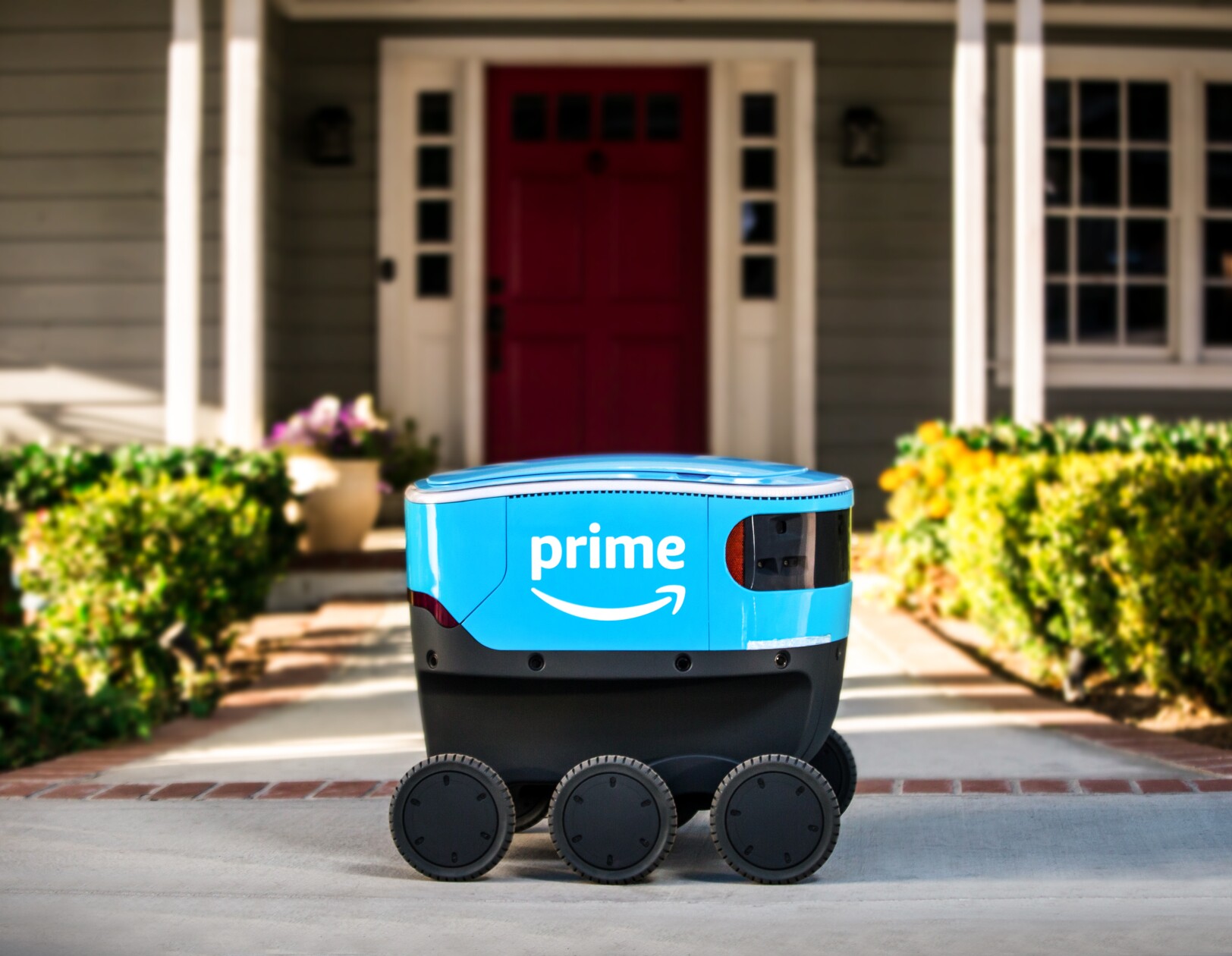
"How will delivery by Amazon Scout work? Customers in Snohomish County order just as they normally would and their Amazon packages will be delivered either by one of our trusted partner carriers or by Amazon Scout. Customers can shop on the Amazon App or amazon.com and enjoy the same delivery options including fast, FREE Same-Day, One-Day and Two-Day shipping for Prime members.

We’re starting with six Amazon Scout devices, delivering packages Monday through Friday, during daylight hours. The devices will autonomously follow their delivery route but will initially be accompanied by an Amazon employee. We developed Amazon Scout at our research and development lab in Seattle, ensuring the devices can safely and efficiently navigate around pets, pedestrians and anything else in their path."
Meet Scout | Amazon blog

Apple just dismissed more than 200 employees from Project Titan, its autonomous vehicle group | CNBC

Also note, from Apple shrinks autonomous vehicle team by 200 employees | The Verge: "However, despite this apparent reduced focus, the amount of self-driving cars Apple is testing on the roads has continued to increase, with the company having more registered test vehicles in California than Google’s autonomous spin-off Waymo as of March 2018."
"Apple dismissed just over 200 employees this week from Project Titan, its stealthy autonomous vehicle group, people familiar with the matter told CNBC.

An Apple spokesperson acknowledged the lay-offs and said the company still sees opportunity in the space:

"We have an incredibly talented team working on autonomous systems and associated technologies at Apple. As the team focuses their work on several key areas for 2019, some groups are being moved to projects in other parts of the company, where they will support machine learning and other initiatives, across all of Apple," the spokesperson said."
Apple just dismissed more than 200 employees from Project Titan, its autonomous vehicle group | CNBC

China Appears to Block Microsoft’s Bing as Censorship Intensifies | NYT

Later in the article: "Blocking Bing would brick over one of the last holes in a wall of online filters that has isolated China’s internet from the rest of the world." Also see China Blocks Microsoft's Bing Due to Technical Error, Sources Say | Bloomberg. In other China + technology news, see In Davos, U.S. executives warn that China is winning the AI race | Washington Post
"Under China’s president, Xi Jinping, the last vestiges of the global internet have slowly disappeared from an online world that had already shut out Twitter, Google and Facebook.

Now one of the last survivors, Microsoft’s Bing search engine, appears to have joined them — even though the American company already censors its results in China.

The Chinese government appeared to block the search engine on Wednesday, in what would be a startling renunciation of more than a decade of efforts by Microsoft to engage with Beijing to make its products available. If the block proves to be permanent, it would suggest that Western companies can do little to persuade China to give them access to what has become the world’s largest internet market by users, especially at a time of increased trade and economic tensions with the United States."
China Appears to Block Microsoft’s Bing as Censorship Intensifies | NYT

Wednesday, January 23, 2019

Never Tweet | NYT

From a timely Twitter/journalism reality check
"So it was just another weekend on Twitter. But in its zigs and zags, the Covington story made one thing clear: Twitter is ruining American journalism.

The Covington saga illustrates how every day the media’s favorite social network tugs journalists deeper into the rip currents of tribal melodrama, short-circuiting our better instincts in favor of mob- and bot-driven groupthink. In the process, it helps bolster the most damaging stereotypes of our profession. Instead of curious, intellectually honest chroniclers of human affairs, Twitter regularly turns many in the news — myself included — into knee-jerk outrage-bots reflexively set off by this or that hash-tagged cause, misspelled presidential missive or targeted-influence campaign.

But Twitter isn’t just ruining the media’s image. It’s also skewing our journalism. Everything about Twitter’s interface encourages a mind-set antithetical to journalistic inquiry: It prizes image over substance and cheap dunks over reasoned debate, all the while severely abridging the temporal scope of the press."
Never Tweet | NYT

Family says hacked Nest camera warned them of North Korean missile attack | Washington Post

You're securing it wrong...
"Calls to 911 and Nest confirmed there was no danger. Instead, a Nest supervisor explained to the family they were probably victims of a “third-party hack,” granting someone access to their cameras and its speakers through a compromised password.

Google, which owns Nest, told the Mercury News that Nest was not breached.

“These recent reports are based on customers using compromised passwords (exposed through breaches on other websites). In nearly all cases, two-factor verification eliminates this type of the security risk,” Nest said in an email statement to the Mercury News. The firm said it is “actively introducing features” that will reject compromised passwords, allow customers to monitor access to their accounts and track external entities that abuse credentials."
Family says hacked Nest camera warned them of North Korean missile attack | Washington Post

Google Gives Wikimedia Millions—Plus Machine Learning Tools | Wired

Significant search synergy
"GOOGLE IS POURING an additional $3.1 million into Wikipedia, bringing its total contribution to the free encyclopedia over the past decade to more than $7.5 million, the company announced at the World Economic Forum Tuesday. A little over a third of those funds will go toward sustaining current efforts at the Wikimedia Foundation, the nonprofit that runs Wikipedia, and the remaining $2 million will focus on long-term viability through the organization’s endowment.

Google will also begin allowing Wikipedia editors to use several of its machine learning tools for free, the tech giant said. What's more, Wikimedia and Google will soon broaden Project Tiger, a joint initiative they launched in 2017 to increase the number of Wikipedia articles written in underrepresented languages in India, and to include 10 new languages in a handful of countries and regions. It will now be called GLOW, Growing Local Language Content on Wikipedia."
Google Gives Wikimedia Millions—Plus Machine Learning Tools | Wired

Cloud, services fuel IBM's profit beat, robust outlook; shares jump | Reuters

Tbd when the IBM public cloud data center investment write-off will be taken... Also see IBM’s stock jumps 7% despite another decline in revenue | SiliconAngle
"IBM’s cloud strategy has focused on helping companies stitch together multiple cloud platforms rather than compete head on with “hyperscale” cloud providers such as Amazon Web Services (AMZN.O), Microsoft Azure (MSFT.O) and Alphabet Inc’s Google (GOOGL.O).

IBM’s cloud business overall grew 12 percent to $19.2 billion in 2018. It is one area IBM has actively looked to build and part of its “Strategic Imperatives,” which also include analytics, cybersecurity and artificial intelligence.

The core cloud businesses performed “quite well” in the quarter and is consistent with an overall view that enterprises are increasingly moving into the full-scale cloud migration, MoffettNathanson analyst Lisa Ellis said."
Cloud, services fuel IBM's profit beat, robust outlook; shares jump | Reuters