Wednesday, October 24, 2018

Y Combinator plans to back carbon removal ventures | MIT Technology Review

See Carbon Removal Technologies | YC Request for Startups for more details
"Background: A growing amount of research concludes it will be nearly impossible for the world to avoid a dangerous 2˚C rise in global temperatures merely by cutting greenhouse gas emissions, given the concentrations already in the atmosphere and the slow pace at which nations are shifting to clean energy. At this stage, the UN’s climate change panel and other institutions have said various methods of capturing and storing carbon dioxide will be required as well.

The problem is that scientists and companies haven’t yet figured out a way to do so economically at anywhere near the scale required.

“It's time to invest and avidly pursue a new wave of technological solutions to this problem—including those that are risky, unproven, even unlikely to work," Y Combinator said in an announcement on Tuesday. "It's time to take big swings at this.”"
Y Combinator plans to back carbon removal ventures | MIT Technology Review

Wikipedia chief’s news website axes all its journalists | The Times

Also see Letter from Jimmy and Orit: What we have learned so far | WikiTribune
"Signs that the original approach was failing emerged in May when Mr Wales admitted that the site “didn’t get much work done”. He compared it to Nupedia, a Wikipedia predecessor he founded in 1999 but which closed in 2003, and which is seen to have failed because its rigorous quality standards discouraged public involvement.

“I listened to advice that we had to be very controlled. We had to have a complex review process. We basically ended up building Nupedia again. Doh! It was beautiful and what we published was of high quality, but we didn’t really have genuine community control, and we didn’t get very much work done,” he wrote."
Wikipedia chief’s news website axes all its journalists | The Times

Tuesday, October 23, 2018

Apple iPhone XR Review: Better than Good Enough | The Verge

Also see iPhone XR: The best $250 you ever saved on a new phone | The Washington Post, which starts "Lately, Apple has made shopping for an iPhone complicated. So let me simplify: If you’re in the market for an upgrade, buy the iPhone XR."
"If one thing is clear about the iPhone XR, it’s that Apple is going to sell tons of these. They’re huge upgrades from the iPhone 6 era of Apple phones, with the latest processors and cameras, a big screen in an updated design, and a competitive opening price of $750 for the 64GB model. That’s $50 less than the smaller Pixel 3. It’s priced to move.

When I first picked up the iPhone XR, it felt like the big questions would be about what the XR was missing compared to the XS. But now that I’ve used this thing for a while, that seem like the wrong way to think about it. The real question for iPhone buyers is whether the high-res OLED display on the XS is worth $250 more than the XR. Because otherwise, the XR offers almost everything you’d want in a 2018 phone."
Apple iPhone XR Review: Better than Good Enough | The Verge

Oculus Co-Founder’s Departure Could Mean Bad Things for Facebook VR | Gizmodo

Facebook senior exec exit of the week
"Facebook made a splashy entrance into VR when it purchased fledgling startup Oculus back in 2014 for $2.3 billion. However, even after putting out the first consumer-ready Oculus Rift in 2016, which was followed up by this year’s Oculus Go and the upcoming Oculus Quest, today’s departure of Oculus co-founder and former CEO Brendan Iribe casts doubts on the future of Facebook’s VR efforts.
[...]
Where things start to get spicy is that, according to TechCrunch, one of Iribe’s main projects was overseeing work on a second-gen Oculus Rift, an effort that reportedly was canceled last week after some “internal shake-ups.” Sources who spoke to TechCrunch claim that Iribe and the Facebook team had “fundamentally different views on the future of Oculus that grew deeper over time,” with Iribe apparently not wanting to participate in a VR “race to the bottom.”"
Oculus Co-Founder’s Departure Could Mean Bad Things for Facebook VR | Gizmodo

Amazon exec and Super Micro CEO call for retraction of spy chip story | The Verge

Perhaps it wasn't the best topic domain for a cover story... Also see Your move, Bloomberg | The Washington Post
"Last week, Apple CEO Tim Cook called for Bloomberg to retract a report claiming that Chinese spies smuggled malicious microchips into a company server. In an unprecedented move, Cook sat down for an interview with BuzzFeed News last week in order to address the allegations proposed in the Bloomberg report. Cook said, “This did not happen. There’s no truth to this,” eventually calling for the publication to retract the story which he said Apple had been denying in conversations with reporters for months.

The other two companies named in the story, Amazon and Super Micro, decided to follow in Apple’s footsteps today, offering their own statements condemning the allegations."
Amazon exec and Super Micro CEO call for retraction of spy chip story | The Verge

Dyson Picks Singapore to Build Electric Cars Rivaling Tesla | Bloomberg

Later in the article: "Exactly what type of cars Dyson will be producing remains to be revealed. Construction is still ongoing at its test facility at Hullavington, England, which includes a now 400-strong automotive team, a handling track and an off-road route."
"The country also has a free trade agreement with China, the world’s largest market for electric cars. While Tesla last week took a step toward building an auto plant in Shanghai, Dyson’s founder, James Dyson, has complained about IP theft in China.
China will remain the top electric-vehicle market at least until 2040, when more than half of all new car sales and a third of the planet’s fleet -- equal to 559 million automobiles -- will be electric, according to a forecast by Bloomberg NEF. James Dyson said the company’s “center of gravity” has tilted toward Asia, which last year generated almost three quarters of revenue growth."
Dyson Picks Singapore to Build Electric Cars Rivaling Tesla | Bloomberg

Google Home Hub review: the smart display to buy | The Guardian

Also see Google Home Hub review: the best digital photo frame | The Verge
"The Google Home Hub is arguably the best smart display on the market. It’s much smaller than you might expect, with a really good-looking 7in screen that appears to be mounted into a small fabric cushion that’s only visible at the bottom.

It’s a simple, understated design that blends in well with furnishings, and would be as at home on a book case or mantle piece as on a table or work surface side. The lack of a camera is probably a plus point for those, like me, who will never video call anyone, and you can still do things on the touchscreen with the mic muted."
Google Home Hub review: the smart display to buy | The Guardian

Monday, October 22, 2018

Tech lobby outlines its own set of privacy regulations | Axios

See this ITI press release for details
"A leading tech lobbying group in Washington Monday introduced a plan for regulations to protect user privacy online, becoming the latest player to try to shape new legislation that the industry sees as increasingly likely.

The big picture: Lawmakers in Washington — spurred on by new rules enacted in Europe and California — are trying to craft their own privacy legislation. Industry groups are laying out their own guidelines for policymakers as they look to shape the debate.

Details: The framework from ITI, whose members include Google and Facebook, is designed to guide policymakers in the United States and around the world as they weigh concerns about data privacy online, said ITI president Dean Garfield."
Tech lobby outlines its own set of privacy regulations | Axios

Republicans Find a Facebook Workaround: Their Own Apps | NYT

Later in the article: "“It’s creating a safe space for people who share a viewpoint, who feel like the open social networks are not fun places for them.”" On a related note, see To Curb Terrorist Propaganda Online, Look to YouTube. No, Really. | Wired
"The apps deliver curated partisan news feeds on what are effectively private social media platforms, free from the strictures and content guidelines imposed by Silicon Valley giants. Some allow supporters to comment on posts or contribute their own, with less risk that their posts will be flagged as offensive or abusive.

Many apps have video-game-like features where users can earn points for making campaign donations or contacting their legislators. Amass enough points and a supporter can attain increasing status levels — like “BigLeague” or “Patriot” — or even gain a spot on the app’s leader board.

Crucially, these mini-platforms harness the powerful reach of platforms like Facebook and Twitter even while competing with them. Some apps give users the option of posting on Twitter or Facebook messages that are scripted by the campaigns, combining the seeming authenticity of organic social media posts with the message discipline of paid advertising."
Republicans Find a Facebook Workaround: Their Own Apps | NYT

Elon Musk says first tunnel for proposed underground transportation network will open in December | LA Times

Also see Elon Musk’s Boring Company announces completion and launch of first tunnel by December | Electrek
"Elon Musk announced Sunday that the first tunnel of a proposed underground transportation network across Los Angeles County would open Dec. 10.
“The first tunnel is almost done,” Musk wrote to his 23.1 million followers shortly after 5 p.m.
Musk’s Boring Co. is building the tunnel beneath the city of Hawthorne, part of his grand vision for a transportation network that whisks commuters across the county.
The company has said its technology could move drivers, as well as pods carrying passengers and bicyclists, through tunnels at speeds of up to 130 mph."
Elon Musk says first tunnel for proposed underground transportation network will open in December | LA Times

Friday, October 19, 2018

Facebook hires former deputy PM Sir Nick Clegg | BBC

Later in the article: "The BBC understands Facebook founder Mark Zuckerberg and chief operating officer Sheryl Sandberg were personally involved in the recruitment."
"Facebook has hired former deputy prime minister Sir Nick Clegg as head of its global affairs and communications team.
The 51-year-old politician was leader of the Liberal Democrats and formed a coalition government with David Cameron and the Conservatives in 2010."
Facebook hires former deputy PM Sir Nick Clegg | BBC

Exclusive: Twitter pulls down bot network that pushed pro-Saudi talking points about disappeared journalist | NBC News

Also see Conservatives mount a whisper campaign smearing Khashoggi in defense of Trump | The Washington Post
"Twitter suspended a network of suspected Twitter bots on Thursday that pushed pro-Saudi Arabia talking points about the disappearance of journalist Jamal Khashoggi in the past week.

Twitter became aware of some of the bots on Thursday when NBC News presented the company with a spreadsheet of hundreds of accounts that tweeted and retweeted the same pro-Saudi government tweets at the same time.

The list was compiled by Josh Russell, an Indiana-based information technology professional who has previously identified foreign influence campaigns on Twitter and Reddit."
Exclusive: Twitter pulls down bot network that pushed pro-Saudi talking points about disappeared journalist | NBC News

Facebook has a fake news 'war room' – but is it really working? | The Guardian

Also see Inside Facebook's Plan to Safeguard the 2018 Election | Wired and Fighting Election Interference in Real Time | Facebook Newsroom
"The stakes are high as the US approaches critical midterm elections in November and the 2020 presidential race. WhatsApp, the Facebook-owned messaging service, has also been linked to widespread false news stories that have led to violence and mob lynchings in India. The platform has further struggled to mitigate harms it is causing in Myanmar, where an explosion of social media hate speech has contributed to violence and genocide. American hate groups and far-right activists have also weaponized the site.

On Wednesday morning, a group of journalists crowded outside a windowless room, snapping iPhone photos of a closed door with a small sign stuck to it that said “WAR ROOM” in red letters. Inside, digital dashboards displayed real-time information about activity on the platform. CNN played in the background, and the wall displayed a large American flag and motivational posters saying “Focus on impact” and “Bring the world closer together”."
Facebook has a fake news 'war room' – but is it really working? | The Guardian

Apple announces iPad Pro and Mac event for October 30th | The Verge

10/30 10:00 Eastern
"Apple isn’t done with product events for 2018. Today the company issued media invites for an October 30th event in Brooklyn, New York where it’s widely expected we’ll see new iPad Pro tablets and potentially several updates to the Mac lineup. The event’s tagline is “there’s more in the making,” and its location is a bit of a surprise. It was reasonable to believe Apple would again present its new products in the Steve Jobs Theater at Apple Park after last month’s iPhone event.
[...]
The new iPad Pro is rumored to have slim bezels and Face ID, expanding Apple’s your-face-is-your-passcode technology beyond the iPhone for the first time. It’s also been reported that this year’s iPad Pro will switch over from Lightning to USB-C and be available in 11- and 12.9-inch display sizes.

The October event is where Apple will likely announce its long-awaited successor to the MacBook Air laptop. In August, Bloomberg reported that the laptop will have slimmer bezels than the Air and have a high-resolution Retina display. It’s expected to slot in beneath the 12-inch MacBook as the company’s new low-cost laptop option."
 Apple announces iPad Pro and Mac event for October 30th | The Verge

Tesla chief Elon Musk unveils a $35,000 Model 3 (that actually costs a bit more) | The Washington Post

New Musk math; on a related note, see 5 Automakers Closest To Losing The Federal Tax Credit (Inside EVs)
"Musk said on Twitter that the sedan, with its “mid-range” battery pack, would cost $35,000, bringing it in line with the mass-market model he had promised for years would revolutionize the availability of electric cars.

But that price takes into account federal and state tax rebates. Before the discounts, it will sell for $45,000 — though the company says buyers should think of the car as far cheaper, because of the money they’ll save on gas.

Musk sparked a frenzy of customer reservations in 2016 when he said the Model 3 would cost $35,000 before incentives, such as a $7,500 federal tax credit — a price point that would help Tesla expand beyond its traditional range of well-heeled buyers. That model, however, remains delayed until 2019, the company said Thursday."
Tesla chief Elon Musk unveils a $35,000 Model 3 (that actually costs a bit more) | The Washington Post

Thursday, October 18, 2018

Facebook tentatively concludes spammers were behind recent data breach: WSJ | Reuters

Back to business as usual?...
"Facebook Inc. has tentatively concluded that spammers looking to make money, and not a nation-state, were behind the largest-ever data theft at the social media company, the Wall Street Journal reported on Wednesday.
The people behind the attack were a group of Facebook and Instagram spammers that present themselves as a digital marketing company, and whose activities were previously known to Facebook’s security team, the Journal reported, citing people familiar with the company's internal investigation."
Facebook tentatively concludes spammers were behind recent data breach: WSJ | Reuters

Are Consumers Worried Enough to Buy a Personal Computer Server? | Bloomberg

Perhaps a less cloudy future for personal information management?
"Servers make the modern internet possible. Millions of these workhorse computers hum away in remote data centers of Alphabet Inc.’s Google, Amazon.com Inc. and Microsoft Corp. running websites, sending information to smartphone apps and crunching data for cloud-based software programs.

Privacy Labs Inc., a startup based near Microsoft headquarters just outside Seattle, wants to upend all this in the name of digital security. On Wednesday, it began selling a server that runs email, contacts and calendar services through a personal web domain. The Helm Personal Server is an angular gadget, about the size of an open paperback book, that sits on a side table or desk rather than in a data center. Information is stored and encrypted on the device, not in the cloud."
Are Consumers Worried Enough to Buy a Personal Computer Server? | Bloomberg

Watch Out Workers, Algorithms Are Coming to Replace You — Maybe -- NYT

From a timely AI reality check, part of a NYT AI special report
"Over the past five years, the Israeli author and historian Yuval Noah Harari has quietly emerged as a bona fide pop-intellectual. His 2014 book “Sapiens: A Brief History of Humankind” is a sprawling account of human history from the Stone Age to the 21st century; Ridley Scott, who directed “Alien,” is co-leading its screen adaptation. Mr. Harari’s latest book, “21 Lessons for the 21st Century,” is an equally ambitious look at key issues shaping contemporary global conversations — from immigration to nationalism, climate change to artificial intelligence. Mr. Harari recently spoke about the benefits and dangers of A.I. and its potential to upend the ways we live, learn and work. The conversation has been edited and condensed."
Watch Out Workers, Algorithms Are Coming to Replace You — Maybe -- NYT

Craig Newmark, Newspaper Villain, Is Working to Save Journalism -- NYT

From a profile of Craig's to-do list
"Craigslist was fast, free and popular, which means you could be pretty sure of getting what you wanted or getting rid of what you didn’t want.

Newspaper income from classifieds, which had provided up to 40 percent of the industry’s revenue, immediately plummeted. Researchers eventually estimated that Craigslist had drained $5 billion from American newspapers over a seven-year period. In the Bay Area, the media was especially hard hit
Mr. Newmark is trying to stop the bleeding — although not here. He is among a gaggle of West Coast technology moguls who are riding to the rescue of the beleaguered East Coast media."
Craig Newmark, Newspaper Villain, Is Working to Save Journalism -- NYT

Computer Stories: A.I. Is Beginning to Assist Novelists -- NYT

Author different
"Unlike Mr. French a quarter-century ago, Mr. Sloan probably will not use his computer collaborator as a selling point for the finished book. He’s restricting the A.I. writing in the novel to an A.I. computer that is a significant character, which means the majority of the story will be his own inspiration. But while he has no urge to commercialize the software, he is intrigued by the possibilities. Megasellers like John Grisham and Stephen King could relatively easily market programs that used their many published works to assist fans in producing authorized imitations.

As for the more distant prospects, another San Francisco Bay Area science fiction writer long ago anticipated a time when novelists would turn over the composing to computerized “wordmills.” In Fritz Leiber’s “The Silver Eggheads,” published in 1961, the human “novelists” spend their time polishing the machines and their reputations. When they try to rebel and crush the wordmills, they find they have forgotten how to write."
Computer Stories: A.I. Is Beginning to Assist Novelists -- NYT

Wednesday, October 17, 2018

Scribd partners with The New York Times for a cheaper joint subscription -- The Verge

For anyone looking for a lot more to read... (Note: the offer is for new subscribers only, but I assume current NYT subscribers can cancel their existing subscriptions and sign up for the bundle)
"If you already have or are looking into a subscription for The New York Times, then Scribd has a bundle for you that’s a great deal: for $12.99 a month, you can subscribe to both NYT and Scribd.

Scribd is an unlimited reading subscription service that enables you to read books, newspapers, and magazines, as well as listen to audiobooks. The new plan extends beyond just Scribd — which is $8.99 monthly — and includes the entirety of The New York Times website. As part of the bundle, you also get access to The New York Times Digital Archive, and The New York Times app via their Basic Digital Access plan. Usually, a full NYT subscription costs $14.99 monthly."
Scribd partners with The New York Times for a cheaper joint subscription -- The Verge

Facebook is reportedly working on a TV camera that can stream video -- The Verge

In other Facebook news, see It turns out that Facebook could in fact use data collected from its Portal in-home video device to target you with ads (Recode)
"Earlier this month, Facebook announced Portal, a camera-equipped smart device that’s meant to compete with Amazon’s Echo Show. But the company’s hardware ambitions apparently go far beyond that: Cheddar is reporting that Facebook is working on a TV camera that would offer Portal-like video chatting on a bigger screen and allow users to stream content from Facebook Watch.

If the device — said to be codenamed “Ripley” — makes it to market, Facebook would enter into another massive smart home battleground, facing off against Amazon, Apple, Google, and Roku for valuable set-top box space. Facebook’s addition of a camera, which essentially turns your entire TV into a massive Facebook Portal, would be a differentiator for the current marketplace. (Microsoft already tried this exact thing with Skype for the Xbox One’s Kinect camera, down to the in-room tracking.)"
Facebook is reportedly working on a TV camera that can stream video -- The Verge

Civil’s token sale has failed. Now what? Refunds, for one thing — and then another sale -- NiemanLab

Also see What's Next for Civil (Civil founder Matthew Iles)
"It was clear — definitely by midnight last night, but also in the days and weeks leading up to yesterday — that journalism blockchain platform Civil’s initial coin offering, in which it aimed to raise $8 million, was not going to work. Civil ended up raising about $1.4 million, and around three-quarters of that was acquired by ConsenSys, Civil’s seed investor.

Some of the things that went wrong are clear. It was very hard to buy into Civil, though in the last couple of weeks the company had started letting people buy tokens with cash and was also, up to the last minute, asking possible contributors to email Civil customer service for help buying tokens.

“The biggest things to know are that a) we’re going to try this again in the near future, under more reasonable terms; and b) this doesn’t impact the grant funding for any of Civil’s initial, ‘First Fleet’ newsrooms, which will continue publishing per the terms of their respective agreements,” Civil cofounder Matt Coolidge told me in an email."
Civil’s token sale has failed. Now what? Refunds, for one thing — and then another sale -- NiemanLab

'Swipe right to sue’: Now you can file lawsuits the same way you find hookups on Tinder -- The Washington Post

Sue different
"Exorbitant legal fees, seemingly endless bureaucracy and an uncertain time investment mean that the decision to pursue legal action against a company or an individual is often fraught with hesitation.

But the founder of a legal-services app says his product now allows users to sue someone with their smartphones and claim awards from class-action lawsuits the same way they’d select a match on Tinder -- with a quick “swipe right to sue.”

Since those new services launched Wednesday, the app, known as DoNotPay, has been downloaded more than 10,000 times, according to its founder, Joshua Browder, a 21-year-old senior at Stanford University who has been labeled the “Robin Hood of the Internet.” As an 18-year-old, Browder created a bot that helped people fight parking tickets in New York, London and Seattle, and he later created another bot to help people sue Equifax after a data breach left 143 million American consumers vulnerable to identity theft last year."
'Swipe right to sue’: Now you can file lawsuits the same way you find hookups on Tinder -- The Washington Post

Facebook’s former security chief warns of tech’s ‘negative impacts’ — and has a plan to help solve them -- The Washington Post

Also see Facebook’s ex-security chief will start a new center to bring Washington and Silicon Valley together (The Verge)
"“There aren’t processes to thoughtfully think through these trade-offs,” he said in an interview ahead of his talk at the university’s Center for International Security and Cooperation. “You end up with these for-profit, very powerful organizations that are not democratically accountable, making decisions that are in their best and often short-term interest … without there being a much more open and democratic discussion of what these issues are.”

He hopes the new initiative, called the Stanford Internet Observatory, will help unite “sometimes warring factions” of academia, tech companies and Washington policymakers to work together to help solve “the negative impacts technology can have on society,” he said."
Facebook’s former security chief warns of tech’s ‘negative impacts’ — and has a plan to help solve them -- The Washington Post

Tuesday, October 16, 2018

As the Internet Splinters, the World Suffers -- NYT

Final paragraphs:
"What this future will bring for Europe and the United States is not clear. Mr. Gomes’s leaked speech from inside Google sounded almost dystopian at times. “This is a world none of us have ever lived in before,” Mr. Gomes told employees. “All I am saying, we have built a set of hacks, and we have kept them.” He seemed to hint at scenarios the tech sector had never imagined before. The world may be a very different place since the election of Donald Trump, but it’s still hard to imagine that what’s deployed in China will ever be deployed at home. Yet even the best possible version of the disaggregated web has serious — though still uncertain — implications for a global future: What sorts of ideas and speech will become bounded by borders? What will an increasingly disconnected world do to the spread of innovation and to scientific progress? What will consumer protections around privacy and security look like as the internets diverge? And would the partitioning of the internet precipitate a slowing, or even a reversal, of globalization?

A chillier relationship with Europe and increasing hostilities with China spur on the trend toward Balkanization — and vice versa, creating a feedback loop. If things continue along this path, the next decade may see the internet relegated to little more than just another front on the new cold war."
As the Internet Splinters, the World Suffers -- NYT

Fidelity just made it easier for hedge funds and other pros to invest in cryptocurrencies -- CNBC

Highlights below; for more details, see Fidelity Digital Assets: The Journey From Idea To Market (Fidelity Digital Assets on Medium):
  • "Fidelity Investments, which administers more than $7.2 trillion in client assets, announced a new and separate company called Fidelity Digital Asset Services on Monday.
  • The firm will handle custody for cryptocurrencies such as bitcoin and will execute trades on multiple exchanges for investors such as hedge funds and family offices. 
  • Other crypto companies have debuted similar products, but Fidelity is the first Wall Street incumbent to officially provide cryptocurrency solutions such as custody. 
  • “Our goal is to make digitally native assets, such as bitcoin, more accessible to investors,” Fidelity Investments Chairman and CEO Abigail Johnson says."
Fidelity just made it easier for hedge funds and other pros to invest in cryptocurrencies -- CNBC

M.I.T. Plans College for Artificial Intelligence, Backed by $1 Billion -- NYT

For more details, see MIT reshapes itself to shape the future (MIT News)
"Every major university is wrestling with how to adapt to the technology wave of artificial intelligence — how to prepare students not only to harness the powerful tools of A.I., but also to thoughtfully weigh its ethical and social implications. A.I. courses, conferences and joint majors have proliferated in the last few years.

But the Massachusetts Institute of Technology is taking a particularly ambitious step, creating a new college backed by a planned investment of $1 billion. Two-thirds of the funds have already been raised, M.I.T. said, in announcing the initiative on Monday.
[...]
The goal of the college, said L. Rafael Reif, the president of M.I.T., is to “educate the bilinguals of the future.” He defines bilinguals as people in fields like biology, chemistry, politics, history and linguistics who are also skilled in the techniques of modern computing that can be applied to them."
M.I.T. Plans College for Artificial Intelligence, Backed by $1 Billion -- NYT

Did Uber Steal Google's Intellectual Property? -- The New Yorker

Final paragraphs from an approximately 9.7K-word profile:
"Levandowski is upset that some people have cast him as the bad guy. “I reject the notion that I did something unethical,” he said. “Was I trying to compete with them? Sure.” But, he added, “I’m not a thief, and I’m not dishonest.” Other parents sometimes shun him when he drops his kids off at school, and he has grown tired of people taking photographs of him when he walks through airports. But he is confident that his notoriety will subside. Although he no longer owns the technology that he brought to Google and Uber, plenty of valuable information remains inside his head, and he has a lot of new ideas. An investment fund recently started due diligence on one of his proposals: a new self-driving-truck company. He anticipates that some of the funding for it will come from overseas, including from Chinese investors. It is ironic, given that federal trade-secret laws were written to prevent intellectual property from travelling abroad, that a trade-secret prosecution may push Levandowski into foreign hands. But he’s fine with it; what he cares about is having a next act. There are work-arounds, it seems, for everything, even for an unsavory past.

“The only thing that matters is the future,” he told me after the civil trial was settled. “I don’t even know why we study history. It’s entertaining, I guess—the dinosaurs and the Neanderthals and the Industrial Revolution, and stuff like that. But what already happened doesn’t really matter. You don’t need to know that history to build on what they made. In technology, all that matters is tomorrow.”"
Did Uber Steal Google's Intellectual Property? -- The New Yorker

How Sears Was the Amazon of Its Day -- NYT

Excerpts:
"High up in the Sears Tower, management couldn’t see that the retail landscape was changing. Sears couldn’t compete effectively with Walmart and the growth of big box merchandisers such as Toys “R” Us. But more important, the company could not summon the vision to anticipate the internet. By 1993, Sears had closed its national network of warehouses and exited the catalog business — which is basically e-retailing without the “e.” Amazon shipped its first book in 1995.
[...]
Certainly, Amazon looks unassailable in its current form. So did every retailer that became the biggest dog on retail’s porch. They were all innovative. They all pushed the boundaries on pricing, sourcing, marketing, regulation, employment, expansion and tax breaks. They all ultimately lost their way. Sears is the latest chapter in that story. And probably not the last."
How Sears Was the Amazon of Its Day -- NYT

Expanding Our Policies on Voter Suppression -- Facebook Newsroom

No, Brad Parscale, the post subject is not about new Facebook service offerings for political campaigns; also see Exclusive: Facebook to ban misinformation on voting in upcoming U.S. elections (Reuters)
"As part of our ongoing efforts to prevent people from misusing Facebook during elections, we’re broadening our policies against voter suppression — action that is designed to deter or prevent people from voting. These updates were designed to address new types of abuse that we’re seeing online.

We already prohibit offers to buy or sell votes as well as misrepresentations about the dates, locations, times and qualifications for casting a ballot. We have been removing this type of content since 2016. Here is an example:


Last month, we extended this policy further and are now banning misrepresentations about how to vote, such as claims that you can vote by text message, and statements about whether a vote will be counted. (e.g. “If you voted in the primary, your vote in the general election won’t count.”) We’ve also recently introduced a new reporting option on Facebook so that people can let us know if they see voting information that may be incorrect, and have set up dedicated reporting channels for state election authorities so that they can do the same."
Expanding Our Policies on Voter Suppression -- Facebook Newsroom

Monday, October 15, 2018

The new Palm is a tiny phone to keep you away from your phone -- The Verge

A new candidate for the future-collector's-item domain
"There’s a new phone with the word “Palm” on it that’s tiny, intriguing, and has very little to do with Palm beyond that word printed on the back. It comes from a startup in San Francisco, which purchased the rights for the name from TCL last year. It costs $349.99 and will be available in November, but you can’t go out and buy it on its own. It’s only available as an add-on to a current line. Also, Steph Curry is somehow involved.

It is a weird little thing.

The Palm phone is a device that you can add on to your Verizon plan, which shares your phone number. It’s a phone designed for you to use on the weekends, when you’re going out for the evening, or just generally when you want to be a little less distracted by your big phone with all its apps. That said, it runs a full version of Android 8.1 and all the apps from the Google Play Store."
The new Palm is a tiny phone to keep you away from your phone -- The Verge

The Big Blockchain Lie -- Project Syndicate

From a timely blockchain reality check; on a related note, see The Prophets of Cryptocurrency Survey the Boom and Bust (The New Yorker)
"In practice, blockchain is nothing more than a glorified spreadsheet. But it has also become the byword for a libertarian ideology that treats all governments, central banks, traditional financial institutions, and real-world currencies as evil concentrations of power that must be destroyed. Blockchain fundamentalists’ ideal world is one in which all economic activity and human interactions are subject to anarchist or libertarian decentralization. They would like the entirety of social and political life to end up on public ledgers that are supposedly “permissionless” (accessible to everyone) and “trustless” (not reliant on a credible intermediary such as a bank).
Yet far from ushering in a utopia, blockchain has given rise to a familiar form of economic hell. A few self-serving white men (there are hardly any women or minorities in the blockchain universe) pretending to be messiahs for the world’s impoverished, marginalized, and unbanked masses claim to have created billions of dollars of wealth out of nothing. But one need only consider the massive centralization of power among cryptocurrency “miners,” exchanges, developers, and wealth holders to see that blockchain is not about decentralization and democracy; it is about greed."
The Big Blockchain Lie -- Project Syndicate

How an Unlikely Family History Website Transformed Cold Case Investigations -- NYT

Solve different
"Aesthetically, GEDmatch.com resembles an internal company wiki in need of an update. But what it offers to researchers and criminal investigators is tremendous flexibility. There are now more than 17 million DNA profiles in genealogical databases, but most of the bigger sites restrict what can be uploaded, banning not only crime scene evidence but anything processed by an external lab. GEDmatch will take it all — blood processed by an obscure lab, spit processed by 23andMe — for free, so long as it’s in the right format.

The site is also useful for people building an extensive family history. The average person can find any number of cousins on existing genealogy sites. But the key, for a genetic sleuth, is figuring out precisely how those cousins are related to a person of interest, and to each other. The tools that Mr. Olson created — primarily because he found the math intriguing — enable users to see the precise genetic segments where cousins overlap. From the site’s one million or so profiles, a skilled genetic detective can often puzzle out an individual’s identity from a single third cousin match.

“There’s nothing else like it,” said Barbara Rae-Venter, a genetic genealogist who used the site to help crack the Golden State Killer case."
How an Unlikely Family History Website Transformed Cold Case Investigations -- NYT

Jeff Hawkins Is Finally Ready to Explain His Brain Research -- NYT

A major milestone for Numenta
"Mr. Hawkins says that before the world can build artificial intelligence, it must explain human intelligence so it can create machines that genuinely work like the brain. “You do not have to emulate the entire brain,” he said. “But you do have to understand how the brain works and emulate the important parts.”

At his company, called Numenta, that is what he hopes to do. Mr. Hawkins, 61, began his career as an engineer, created two classic mobile computer companies, Palm and Handspring, and taught himself neuroscience along the way.

Now, after more than a decade of quiet work at Numenta, he thinks he and a handful of researchers working with him are well on their way to cracking the problem. On Monday, at a conference in the Netherlands, he is expected to unveil their latest research, which he says explains the inner workings of cortical columns, a basic building block of brain function."
Jeff Hawkins Is Finally Ready to Explain His Brain Research -- NYT

Friday, October 12, 2018

Most White Americans’ DNA Can Be Identified Through Genealogy Databases -- NYT

Also see So many people have had their DNA sequenced that they've put other people's privacy in jeopardy (LA Times), which notes "The authors said the same process would work for about 60% of Americans of European descent, who are the people most likely to use genealogical websites, Erlich said. Though the odds of success would be lower for people from other backgrounds, it would still be expected to work for more than half of all Americans, they said."
"The genetic genealogy industry is booming. In recent years, more than 15 million people have offered up their DNA — a cheek swab, some saliva in a test-tube — to services such as 23andMe and Ancestry.com in pursuit of answers about their heritage. In exchange for a genetic fingerprint, individuals may find a birth parent, long-lost cousins, perhaps even a link to Oprah or Alexander the Great.

But as these registries of genetic identity grow, it’s becoming harder for individuals to retain any anonymity. Already, 60 percent of Americans of Northern European descent — the primary group using these sites — can be identified through such databases whether or not they’ve joined one themselves, according to a study published today in the journal Science.

Within two or three years, 90 percent of Americans of European descent will be identifiable from their DNA, researchers found. The science-fiction future, in which everyone is known whether or not they want to be, is nigh."
Most White Americans’ DNA Can Be Identified Through Genealogy Databases -- NYT

Peeling back the curtain: How the Economist is opening the data behind our reporting (The Economist)

Starting with the Big Mac index
"While we take care to identify our sources, we have not often published the data behind them. Sometimes, this is for good reason: some data are proprietary or otherwise not ours to publish. Often, we have simply not made the time to do it. This is a shame: releasing data can give our readers extra confidence in our work, and allows researchers and other journalists to check — and to build upon — our work. So we’re looking to change this, and publish more of our data on GitHub.
Why now?
Years ago, “data” generally meant a table in Excel, or possibly even a line or bar chart to trace in a graphics program. Today, data often take the form of large CSV files, and we frequently do analysis, transformation, and plotting in R or Python to produce our stories. We assemble more data ourselves, by compiling publicly available datasets or scraping data from websites, than we used to. We are also making more use of statistical modelling. All this means we have a lot more data that we can share — and a lot more data worth sharing."
Peeling back the curtain: How the Economist is opening the data behind our reporting (The Economist)

Facebook purged over 800 U.S. accounts and pages for pushing political spam -- The Washington Post

See Removing Additional Inauthentic Activity from Facebook (Facebook Newsroom) for more details; also see Made and Distributed in the U.S.A.: Online Disinformation (NYT)
"Facebook said on Thursday it purged more than 800 U.S. publishers and accounts for flooding users with politically-oriented spam, reigniting accusations of political censorship and arbitrary decision-making.

In doing so, Facebook demonstrated its increased willingness to wade into the thorny territory of policing domestic political activity. Some of the accounts had been in existence for years, had amassed millions of followers, and professed support for conservative or liberal ideas, such as one page that billed itself as “the first publication to endorse President Donald J. Trump.” Facebook’s ability to monitor manipulation of users is under an intense spotlight in the weeks ahead of the U.S. midterm elections."
Facebook purged over 800 U.S. accounts and pages for pushing political spam -- The Washington Post

Thursday, October 11, 2018

After 10 million miles, Waymo's cars are on another level -- CNET

Also ~7 billion miles on simulated roads; see this John Krafcik post for more details on the milestone
"Whenever I talk to John Krafcik, CEO of Waymo (the former Google Self-Driving Car Project), I'm always left with one overriding feeling: sadness for his competition. I've been lucky to ride in many an ostensibly self-driving car. Some were very impressive indeed. Others left me giving thanks the moment I stepped out. But none of the dozens of companies out there working to develop autonomy systems has ever given me the impression that they're anywhere close to what Waymo is doing.

That feeling was reinforced by the announcement today that Waymo's cars have crossed their 10 millionth driverless mile on public roads. 10 million miles. No other company is as transparent as Waymo when it comes to sharing information about testing, and so it's impossible to know for sure, but I don't think any of its rivals come close.

Really, though, numbers don't matter. It's more about lessons learned, and Waymo has evolved to the point where its technology is now having to solve the kind of minutiae that wasn't even on the radar back when this whole thing was still called the Google Self-Driving Car Project."
After 10 million miles, Waymo's cars are on another level -- CNET

Google’s Waze is making a big, nationwide bet on carpooling -- The Verge

See this post by Waze founder Noam Bardin for more details
"For many drivers, Waze is the go-to app for circumnavigating pesky traffic jams. Now, the Alphabet-owned company is making a risky move into ride-hailing — or, more specifically, carpooling. On Wednesday, Waze announced the nationwide rollout of Waze Carpool, a dedicated app that lets drivers offer rides to people who are traveling on a similar route.

First launched in the Bay Area in 2016, Waze Carpool has since expanded to five additional states in the US as well as Waze’s country of origin, Israel. The company says it wants to leverage its “superior routing technology” to help commuters fill empty seats in their cars and, in the process, hopefully reduce the number of cars on the road. And with a community of 100 million active monthly users worldwide, Waze Carpool has big ambitions about its impact on daily transportation habits."
Google’s Waze is making a big, nationwide bet on carpooling -- The Verge

The Battle for the Home -- Stratechery

Final paragraphs from a Stratechery review of Amazon, Google, Apple, and Facebook competition for the next wave of home devices/services
"There is one final question that overshadows all-of-this: while the home may be the current battleground in consumer technology, is it actually a distinct product area — a new epoch if you will? When it came to mobile, it didn’t matter who had won in PCs; Microsoft ended up being an also-ran.

The fortunes of Apple, in particular, depend on whether or not this is the case. If it is a truly new paradigm, then it is hard to see Apple succeeding. It has a very nice speaker, but everything else about its product is worse. On the other hand, the HomePod’s close connection to the iPhone and Apple’s overall ecosystem may be its saving grace: perhaps the smartphone is still what matters.

More broadly, it may be the case that we are entering an era where there are new battles, the scale of which are closer to skirmishes than all-out wars a la smartphones. What made the smartphone more important than the PC was the fact they were with you all the time. Sure, we spend a lot of time at home, but we also spend time outside (AR?), entertaining ourselves (TV and VR), or on the go (self-driving cars); the one constant is the smartphone, and we may never see anything the scale of the smartphone wars again."
The Battle for the Home -- Stratechery

Bitcoin Tumbles as Cryptocurrencies Join Global Asset Selloff -- Bloomberg

A timely *coin reality check
"Cryptocurrencies have wiped out more than $600 billion in value from a January peak as the boom in initial coin offerings last year fades further into memory. Mainstream adoption of digital currencies has failed to materialize this year amid a series of exchange hacks and increased regulatory scrutiny.

“It is clear by now that Bitcoin and other cryptocurrencies represent the mother of all bubbles,” Nouriel Roubini, chairman at Roubini Macro Associates and a professor at NYU Stern School of Business, said in prepared testimony for a U.S. Senate Banking Committee hearing on cryptocurrencies and blockchain scheduled Thursday in Washington. “No asset class in human history has ever experienced such a rapid boom and total utter bust and implosion.”"
Bitcoin Tumbles as Cryptocurrencies Join Global Asset Selloff -- Bloomberg

Wednesday, October 10, 2018

The battle in your ear buds: The bros of political podcasting and their quest to reinvent punditry -- The Washington Post

Later in the article: "Since its January 2017 debut, “Pod Save America” has been downloaded more than 320 million times. What began as a hobby for Obama alumni has morphed into a thriving business that is also a crusade to save a teetering republic." Pod Save America's HBO series special starts Friday.
"Each is “emblematic of an astounding level of political polarization in the United States right now,” says Dannagal G. Young, an associate professor of communication at the University of Delaware. They are united, though, by the ingratiating powers of their increasingly popular medium. The percentage of Americans listening to a podcast every week has more than doubled in the past five years, according to Edison Research.

“Podcasts have become this really viable and popular form of intimate, discursive experience,” Young says. “People are in their cars or at the gym, and listening, and you feel like it’s them talking to you.”"
The battle in your ear buds: The bros of political podcasting and their quest to reinvent punditry -- The Washington Post

A Future Where Everything Becomes a Computer Is as Creepy as You Feared -- NYT

From a timely Internet of Things reality check
"The trouble, though, is that business models for these device don’t often allow for the kind of continuing security maintenance that we are used to with more traditional computing devices. Apple has an incentive to keep writing security updates to keep your iPhone secure; it does so because iPhones sell for a lot of money, and Apple’s brand depends on keeping you safe from digital terrors.

But manufacturers of low-margin home appliances have little such expertise, and less incentive. That’s why the internet of things has so far been synonymous with terrible security — why the F.B.I. had to warn parents last year about the dangers of “smart toys,” and why Dan Coats, the director of national intelligence, has identified smart devices as a growing threat to national security."
A Future Where Everything Becomes a Computer Is as Creepy as You Feared -- NYT

New Pixel Phones and Other Gadgets Keep Google in the Hardware Hunt -- NYT

See this Google post for more details; also see Stop and Ask: Why Does Google Need Hardware? (Bloomberg), which notes "It would be generous to call Google a niche seller of smartphones"
"The gadgets are Google’s third wave since it started making consumer devices in 2016. The internet company has pushed these products as a way to showcase its prowess in areas like artificial intelligence and image processing.

Yet the efforts have not had a meaningful impact on Google’s sales or market share. For a company that makes most of its money selling advertising next to search results, the hardware increasingly appears to be an expensive hobby. One of its biggest hits thus far is a Google-branded wireless router, which is too much of a niche product to serve as the foundation of a hardware strategy."
New Pixel Phones and Other Gadgets Keep Google in the Hardware Hunt -- NYT

Tuesday, October 09, 2018

Google Drops Out of Pentagon's $10 Billion Cloud Competition -- Bloomberg

Later in the article: "“Had the JEDI contract been open to multiple vendors, we would have submitted a compelling solution for portions of it,” the Google spokesman said. “Google Cloud believes that a multi-cloud approach is in the best interest of government agencies, because it allows them to choose the right cloud for the right workload.”"
"Google’s announcement on Monday came just months after the company decided not to renew its contract with a Pentagon artificial intelligence program, after extensive protests from employees of the internet giant about working with the military. The company then released a set of principles designed to evaluate what kind of artificial intelligence projects it would pursue.

“We are not bidding on the JEDI contract because first, we couldn’t be assured that it would align with our AI Principles," a Google spokesman said in a statement. "And second, we determined that there were portions of the contract that were out of scope with our current government certifications.”

The spokesman added that Google is “working to support the U.S. government with our cloud in many ways.”"
Google Drops Out of Pentagon's $10 Billion Cloud Competition -- Bloomberg

Facebook unveils the Portal, a video chat camera for the people who still trust Facebook -- The Washington Post

See this Facebook page for details
"On Monday, Facebook unveiled the $200 Portal, the first-ever consumer hardware from the world’s largest social network. The toaster-size gadget, along with a larger $350 version called Portal+, is a cross between a smart speaker, video camera and digital photo frame. But at a time when CEO Zuckerberg’s privacy and security decisions are a matter of congressional inquiry, how many people will trust one in their living room?

I had a chance to spend a little time with the long-rumored Portal ahead of its launch. As a camera, it offers a nice upgrade to the Skype or FaceTime video chat experience many of us have on a phone or computer. The Portal sits on a shelf or kitchen counter and lets your voice do the dialing. Call out, “Portal, call Geoffrey,” and it’ll ring my home Portal or the Facebook Messenger app on my phone. Facebook’s advantage over other video chat services: Chances are, almost everyone you might want to call already has an account."
Facebook unveils the Portal, a video chat camera for the people who still trust Facebook -- The Washington Post

Google for months kept secret a bug that imperiled the personal data of Google+ users -- The Washington Post

-(consumer(Google+)); see Project Strobe: Protecting your data, improving our third-party APIs, and sunsetting consumer Google+ (Google Keyword blog) for details
"Google discovered the Google+ security bug in the same month that Silicon Valley rival Facebook was facing massive scrutiny over its role in allowing people affiliated with political consultancy Cambridge Analytica to collect data on 87 million users — an incident that led to demands that Facebook chief executive Mark Zuckerberg testify on Capitol Hill. He did so in April.

Google announced in its blog post Monday that it will mostly discontinue Google+, its failing social media offering, limiting it to only business and other enterprise customers. The company also announced new curbs on the information, such as call logs and contact lists, that outside developers can gather on Android, the Google operating system used by most of the world’s smartphones. And it will impose new limits on the data shared about users of its popular email service, Gmail."
Google for months kept secret a bug that imperiled the personal data of Google+ users -- The Washington Post

Friday, October 05, 2018

Introducing the Internet Bill of Rights -- NYT

From Kara Swisher's latest column
"Mr. Berners-Lee, who is widely known as the inventor of the World Wide Web and who advised Mr. Khanna on the creation of his list, agrees. “If the internet is to live up to its potential as a force for good in the world, we need safeguards that ensure fairness, openness and human dignity,” he said in an email. “This Bill of Rights provides a set of principles that are about giving users more control of their online lives while creating a healthier internet economy.”

Ms. Pelosi said that national legislation does not have to be hostile, noting that tech companies know that public sentiment is turning against them. She said that more and more people are “aware that there is some vulnerability with the status quo” and that she believes that “legislation would get public support.”

It already has in Europe — which has become the leader in stopping tech’s aggressive march — and in Ms. Pelosi’s home state, California, which has passed many of the kinds of laws that Congress should be considering."
Introducing the Internet Bill of Rights -- NYT

Google Assistant now helps you compare ride-hailing prices and summon a car -- The Verge

See Book a ride with the Google Assistant (Google Keyword blog) for more details
"After announcing some updates to the Google Assistant user experience yesterday, today Google is rolling out a new way of booking rides with your voice — or at least getting most of the way there. Starting this week, you’ll be able to say “Hey Google, book a ride to” or “Hey Google, get me a taxi to” your destination.

Assistant will then respond by listing off price estimates and current wait times for Uber, Lyft, Ola, Grab, GO-JEK, “and many more” ride-hailing apps, according to Google. You can avoid the longer list and specify your preferred service by using its name when requesting a ride. This works on Android, iPhone, Google Home, and all other smart speakers that have Assistant built in. Support for smart displays is coming soon."
Google Assistant now helps you compare ride-hailing prices and summon a car -- The Verge

Twitter still awash in fake news, study finds -- Politco

Also see More research suggests that Twitter’s fake news “strategy” is either ineffective or nonexistent (NiemanLab)
"Twitter is still rife with “fake news” a month out from the 2018 midterms, with more than 80 percent of the accounts that regularly spread misinformation in 2016 still active, a new study released Thursday found.

The report — sponsored by the nonprofit Knight Foundation and written by George Washington University professor Matthew Hindman and Vlad Barash, the science director at network analysis firm Graphika — found that those accounts together still publish upward of a million tweets a day."
Twitter still awash in fake news, study finds -- Politco

China inserted surveillance microchip in servers used by Amazon and Apple, report says -- The Washington Post

Also see The China SuperMicro Hack: About That Bloomberg Report (Lawfare); tangentially, see Pence’s China Speech Seen as Portent of ‘New Cold War’ (NYT)
"China secretly inserted surveillance microchips into servers used by major technology companies, including Apple and Amazon.com, in an audacious military operation likely to further inflame trade tensions between the United States and its leading source of electronics components and products, Bloomberg Businessweek reported Thursday morning.

The article -- which the companies vigorously denied -- detailed a sweeping years-long effort to install the surveillance chips in servers whose motherboards — the brains of the powerful computers — were assembled in China. One affected company had its servers used by U.S. government clients, including Department of Defense data centers, Navy warships and the CIA in its drone operations."
China inserted surveillance microchip in servers used by Amazon and Apple, report says -- The Washington Post

Elon Musk taunts the SEC days after fraud settlement -- The Washington Post

Looks like somebody hasn't completed his Twitter sensitivity training yet...
"Tesla chief Elon Musk on Thursday taunted federal regulators a few days after reaching a settlement with them over accusations of fraud, alleging they had sued him last week to help his enemies.

“Just want to [say] that the Shortseller Enrichment Commission is doing incredible work. And the name change is so on point!” he tweeted, a jeering reference to the Securities and Exchange Commission, whom he’d settled with five days earlier.

The SEC declined to comment. Tesla did not immediately respond."
Elon Musk taunts the SEC days after fraud settlement -- The Washington Post

Thursday, October 04, 2018

A Former Obama Operative Built a New Anti-Republican Attack Machine -- Bloomberg

Tangentially, see How the Kavanaugh Information War Mirrors Real Warzones (Wired)
"Before he was a banker, Burton, 38, was a practitioner of the dark art of opposition research, or “oppo”—digging up and surreptitiously deploying damaging information about politicians. As it did for so many people, Donald Trump’s election turned Burton’s life upside down. He quit his job, joined a Resistance group, and devoted himself to returning his country to the path he’d believed it was on when he worked for Barack Obama’s campaign a decade ago.

Some Resisters march or knock on doors; others raise money or run for office. Burton felt his gifts lay elsewhere: namely, in tearing down political opponents. Over the past year, backed by mysterious donors, he’s organized what may be the most audacious grass-roots project in the age of Trump. Burton has amassed an army of 16,000 amateur sleuths who, with professional guidance, have spent months ferreting out damaging material on scores of vulnerable Republicans in Congress and state legislatures. Now he’s ready to unleash it just in time for the midterms. As he told me, “We’re going to do with real information and real Americans what the Russians tried to do with fake information and fake Americans.”"
A Former Obama Operative Built a New Anti-Republican Attack Machine -- Bloomberg

Honda Putting $2.75 Billion Into G.M.’s Self-Driving Venture -- NYT

Later in the article: "For now, G.M. and Waymo appear to be ahead of most competitors."
"In the race to develop self-driving cars, General Motors has picked up another hefty ally.

Honda, the Japanese automaker, has agreed to buy a $750 million stake in G.M.’s autonomous vehicles unit, G.M. Cruise Holdings, the two companies said Wednesday. In addition, Honda will contribute $2 billion to the project over the next 12 years.

G.M. is aiming to develop a vehicle — based on its electric Chevrolet Bolt — with no steering wheel or pedals that can be used in driverless taxi and delivery services. The automaker hopes to develop the technology into a new and lucrative line of business, apart from making and selling cars and trucks for consumers."
Honda Putting $2.75 Billion Into G.M.’s Self-Driving Venture -- NYT

More than 250 people worldwide have died taking selfies, study finds -- The Washington Post

Several instances are described on the Darwin Awards site
"More than 250 people worldwide have died while taking selfies in the last six years, according to a new study from researchers associated with the All India Institute of Medical Sciences, a group of public medical colleges based in New Delhi. The findings, which analyzed news reports of the 259 selfie-related deaths from October 2011 to November 2017, were published in the July-August edition of the Journal of Family Medicine and Primary Care.

Of the 259 deaths, researchers found the leading cause to be drowning, followed by incidents involving transportation — for example, taking a selfie in front of an oncoming train — and falling from heights. Other causes of selfie-related deaths include animals, firearms and electrocution."
More than 250 people worldwide have died taking selfies, study finds -- The Washington Post

Microsoft is embracing Android as the mobile version of Windows -- The Verge

I'm reminded of this quote from Paul Allen's Idea Man: A Memoir by the Cofounder of Microsoft (2011): "Here’s what the death knell for the personal computer will sound like: Mainly I use my phone/pad, but I still use my PC to write long e-mails and documents. Most people aren’t there yet, but that’s where we’re headed. If Microsoft fails to catch up in mobile, in other words, it’s in for a long, slow slide."
"Microsoft’s best mobile work is debuting on Android right now, and if you’re a Windows user then Google’s operating system has always felt like the natural companion anyway. As Microsoft can’t replicate a lot of Your Phone functionality on iPhones, Android now feels like the only choice if you want a close mobile connection to a Windows PC.

We’re only at the early stages of Microsoft’s new mobile strategy of making iOS and Android better at connecting to Windows, but it’s clear the company won’t hold back on features to ensure they’re available on iPhones too. Bringing Android apps to Windows 10 PCs through a remote window into your phone is a useful and clever way of keeping Windows 10 users focused on using their PCs more."
Microsoft is embracing Android as the mobile version of Windows -- The Verge

Cloudera and Hortonworks announce $5.2 billion merger -- TechCrunch

And then there were two (Cloudera and MapR)... Tellingly, the body of the deal press release doesn't include a single instance of "Hadoop"...
"Over the years, Hadoop,  the once high-flying open-source platform, gave rise to many companies and an ecosystem of vendors emerged. It was long believed that some major companies would emerge from the pack, and, sure enough, Hortonworks went public in 2014. Cloudera followed three years later, but the market slowed down and the two companies announced today they are merging in a deal worth $5.2 billion, based on the price at the close of business yesterday.
[...]
Doug Henschen, an VP and principal analyst at Constellation Research sees the cloud eating into Hadoop’s market in a big way. “The move to the cloud is, in my view, sapping growth and revenue potential for these companies such that it won’t sustain three profitable players with strong, double-digit growth. Cloudera and Hortonworks have both moved to provide consistent hybrid- and multi-cloud capable services, but I see @AWS EMR and Spark services and similar Azure and Google services as capturing faster growth, and together, the lion’s share of the big data platforms market,” he explained."
Cloudera and Hortonworks announce $5.2 billion merger -- TechCrunch

Wednesday, October 03, 2018

Two of Blockchain's Biggest Consortiums Just Joined Forces -- Coindesk

In other *coin/*chain news, see Coinbase, the startup at the core of the crypto craze, is now considered an $8 billion company (Recode)
"Announced Monday, the Hyperledger Project and the Enterprise Ethereum Alliance (EEA) have agreed to collaborate on bringing common standards to the blockchain space and cross-pollinate a wider open-source community.

This joining of forces is notable as EEA and Hyperledger represent two of the three largest and arguably most influential enterprise blockchain communities, the third being the R3 Corda ecosystem.

If the team-up succeeds in creating common standards between the two platforms, it could sway enterprises previously on the fence to build their blockchains on one or the other, since the risk of creating new silos that don't talk to other systems is being addressed."
Two of Blockchain's Biggest Consortiums Just Joined Forces -- Coindesk

Microsoft Surface Headphones: Hands-on with Microsoft's new Bose-buster noise-canceling headphones -- CNET

Because what the world needs now is Cortana headphones...
"Sure, Microsoft has new Surface PCs. But what the company unveiled alongside those products on Tuesday is a total surprise. It's not a new keyboard or mouse -- but an entry into a totally new product category for the company: a set of premium noise-canceling headphones simply called Surface Headphones, arriving in stores this fall for $350, with a limited release in the US only.

Microsoft doing headphones? It didn't seem as odd as it sounds, because, well, everybody seems to be doing headphones these days. But how good could they be? Or rather: Could they compete with top noise-canceling headphones from Bose and Sony, which also happen to cost around $350?"
Microsoft Surface Headphones: Hands-on with Microsoft's new Bose-buster noise-canceling headphones -- CNET

Why You Shouldn’t Use Facebook to Log In to Other Sites -- NYT

Also see Facebook finds ‘no evidence’ hackers accessed connected apps (TechCrunch)
"The best way is to use a dedicated password manager — a service, like LastPass or 1Password, that creates and remembers strong passwords for different sites. Operating systems and browsers are also getting better at managing passwords; newer iPhones, for instance, let you unlock sites with facial recognition, which is just as convenient as pressing Facebook’s button.

If for some reason you don’t want to use a password manager, you can use another tech giant’s sign-on service. When presented with different ways to sign on to sites, you can choose Google or Microsoft instead of Facebook.

Yes, it’s possible those companies could be hacked one day, too. After all, Yahoo was hacked, as was LinkedIn, as was Equifax. But at this moment, a sign-on service by Google or Microsoft has one big advantage over Facebook’s: Those companies did not lose control of 50 million people’s accounts, and Facebook did."
Why You Shouldn’t Use Facebook to Log In to Other Sites (NYT)

Elon Musk’s Ultimatum to Tesla: Fight the S.E.C., or I Quit -- NYT

Manage different; in other Tesla news, Tesla meets its Model 3 production goals for third quarter (The Washington Post)
"“What it tells us is this board, as a strategic plan, must be using the Jim Jones-Jonestown suicide pact,” Jeffrey Sonnenfeld, a professor at the Yale School of Management, said Friday on CNBC. “They are drinking the Kool-Aid of the founder. It is completely as self-destructive as Musk is.”

But Mr. Musk had given the board little choice: In a phone call with directors before their lawyers went back to federal regulators with a final decision, Mr. Musk threatened to resign on the spot if the board insisted that he and the company enter into the settlement. Not only that, he demanded the board publicly extol his integrity."
Elon Musk’s Ultimatum to Tesla: Fight the S.E.C., or I Quit -- NYT

Tuesday, October 02, 2018

Vigilante engineer stops Waymo from patenting key lidar technology -- Ars Technica

Final paragraph: "Waymo also has hundreds of other patents developed in-house, or bought from rivals. They might not all contain the "magic" claims of 936, but they are probably enough to keep Waymo in the driving seat of autonomous vehicles for some time—especially as Swildens says he's too busy right now to issue any more patent challenges."
"A lone engineer has succeeded in doing what Uber's top lawyers and expert witnesses could not—overturning most of a foundational patent covering arch-rival Waymo's lidar laser ranging devices.

Following a surprise left-field complaint by Eric Swildens, the US Patent and Trademark Office (USPTO) has rejected all but three of 56 claims in Waymo's 936 patent, named for the last three digits of its serial number. The USPTO found that some claims replicated technology described in an earlier patent from lidar vendor Velodyne, while another claim was simply "impossible" and "magic."

Swildens, who receives no money or personal advantage from the decision, told Ars that he was delighted at the news. "The patent shouldn't have been filed in the first place," he said. "It's a very well written patent. However, my personal belief is that the thing that they say they invented, they didn't invent.""
Vigilante engineer stops Waymo from patenting key lidar technology -- Ars Technica

Google announces “Project Stream”—a “test” of game streaming in Chrome -- Ars Technica

Also see Pushing the limits of streaming technology (Google Keyword blog); in other gaming news, see Honour of Kings uses facial recognition to check ages (BBC)
"Google just announced "Project Stream," a "technical test" of a service designed to stream AAA video games à la Playstation Now and GeForce Now. We've heard rumors of a "Project Yeti" gaming service for some time now, and this looks to be the first sign of a real "Google Gaming" product.

The Project Stream test will involve streaming Ubisoft's Assassin’s Creed Odyssey to desktop-class Chrome browsers, which means it will work on Windows, macOS, Linux, and ChromeOS. Google's blog post says that a "limited number of participants" will be able to try the game for free starting October 5. A 25Mbps Internet connection is "recommended" for the service, and you'll need accounts with Google and Ubisoft. For controls, you have options of a keyboard and mouse or a USB (not Bluetooth) game controller. Google says a recent Xbox or Playstation controller will work fine. Provided you are 17 years or older and live in the US, you can sign up at projectstream.google.com."
Google announces “Project Stream”—a “test” of game streaming in Chrome -- Ars Technica

Silicon Valley’s Keystone Problem: ‘A Monoculture of Thought’ -- NYT

Publish different; later in the article: "Her book’s subtitle explains how it should be read: “A Totally Fictional but Essentially True Silicon Valley Story.”"
"Not long ago, it was Jessica Powell’s job to defend Silicon Valley from those who would question its worldview. As the head of public relations at Google, she ran a sprawling team that sought to buff the search company’s image and to keep criticism of the world-dominating, do-everything tech behemoth to a minimum.

A year ago, Ms. Powell left Google. Her departure did not follow the Silicon Valley script; instead of decamping to a Google rival or a hot start-up, she decided to go to graduate school for a master of fine arts in creative writing.

Now the digital publisher Medium is publishing Ms. Powell’s debut novel, “The Big Disruption,” a zany satire set inside a tech giant that bears more than a passing resemblance to a certain internet search company. (The novel is Medium’s first full-length book; it can be read online free.)"
Silicon Valley’s Keystone Problem: ‘A Monoculture of Thought’ -- NYT

Tesla shares soar after Musk settles with SEC -- The Washington Post

In other Tesla news, see Unraveling a Tesla Mystery: Lots (and Lots) of Parked Cars (NYT)
"Tesla shares soared by more than 17 percent Monday after chief executive Elon Musk settled a federal lawsuit over the weekend that could have resulted in his ouster from the company and thrown the all-electric carmaker into chaos.

The Securities and Exchange Commission sued Musk after accusing him of misleading investors when he announced on Twitter in August that he was planning to take the company private and proclaimed that he had already secured the funding to seal the deal. Regulators sought to remove Musk from Tesla and ban the billionaire entrepreneur from serving as chief executive of any public company. The company’s stock dropped by 14 percent following the suit."
Tesla shares soar after Musk settles with SEC -- The Washington Post

Amazon Raises Minimum Wage to $15 for All U.S. Employees, Including Full-Time, Part-Time, Temporary, and Seasonal -- Amazon Press Center

Later in the press release: "“We will be working to gain Congressional support for an increase in the federal minimum wage. The current rate of $7.25 was set nearly a decade ago,” said Jay Carney, Senior Vice President of Amazon Global Corporate Affairs. “We intend to advocate for a minimum wage increase that will have a profound impact on the lives of tens of millions of people and families across this country.”"
"Amazon today announced it is increasing its minimum wage to $15 for all full-time, part-time, temporary (including those hired by agencies), and seasonal employees across the U.S.—effective November 1. The new Amazon $15 minimum wage will benefit more than 250,000 Amazon employees, as well as over 100,000 seasonal employees who will be hired at Amazon sites across the country this holiday.
“We listened to our critics, thought hard about what we wanted to do, and decided we want to lead,” said Jeff Bezos, Amazon Founder and CEO. “We’re excited about this change and encourage our competitors and other large employers to join us.”"
Amazon Raises Minimum Wage to $15 for All U.S. Employees, Including Full-Time, Part-Time, Temporary, and Seasonal -- Amazon Press Center

Monday, October 01, 2018

Internet, social media use and device ownership in U.S. have plateaued after years of growth -- Pew Research

Final paragraph: "Ultimately, the method for tracking certain adoption metrics may need to change. A canvassing of experts by the Center suggested that it might make sense in the near future to stop asking people if they “use the internet” because it will be so ubiquitous. Those experts predicted that the internet would become “like electricity” – almost invisible to users, yet more deeply embedded in their lives."
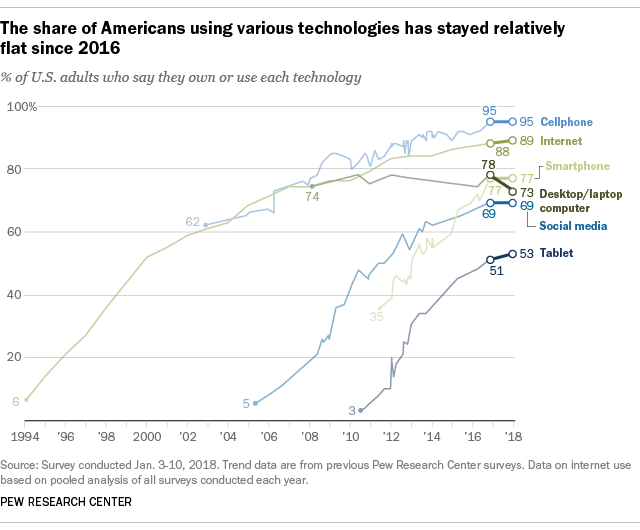
"The use of digital technology has had a long stretch of rapid growth in the United States, but the share of Americans who go online, use social media or own key devices has remained stable the past two years, according to a new analysis of Pew Research Center data.

The shares of U.S. adults who say they use the internet, use social media, own a smartphone or own a tablet computer are all nearly identical to the shares who said so in 2016. The share who say they have broadband internet service at home currently stands at 65% – nearly identical to the 67% who said this in a survey conducted in summer 2015. And when it comes to desktop or laptop ownership, there has actually been a small dip in the overall numbers over the last two years – from 78% in 2016 to 73% today."
Internet, social media use and device ownership in U.S. have plateaued after years of growth -- Pew Research

GE’s $500,000,000,000 Market Wipeout Is Like Erasing Facebook -- Bloomberg

On a related note, see GE ousts CEO John Flannery as it announces $23b writedown (Boston Globe). Tangentially, for a different erasing-Facebook perspective, see Tim Wu's The case for breaking up Facebook and Instagram (The Washington Post)
"On August 28, 2000, Apple’s hottest product was a candy-colored computer, Donald Trump was a New York real estate mogul and General Electric Co. was worth some $600 billion.

Apple and Trump have gone on to greater things. GE? It’s on the verge of a staggering milestone: a half-trillion dollars in market value wiped out since that all-time high 18 years ago. The iconic American corporation is now worth just under $100 billion, its stock at around $11, and investors are signaling they don’t expect things to get better.

The collapse -- an 81 percent drop from the peak -- is all the more startling as it comes amid record-setting market gains. Apple Inc. recently became the first U.S.-based company to top $1 trillion in market value, followed shortly thereafter by Amazon.com Inc."
GE’s $500,000,000,000 Market Wipeout Is Like Erasing Facebook -- Bloomberg

The Trump administration is suing California to quash its new net neutrality law -- The Washington Post

Not neutrality
"California on Sunday became the largest state to adopt its own rules requiring Internet providers like AT&T, Comcast and Verizon to treat all web traffic equally. Golden State legislators took the step of writing their law after the Federal Communications Commission scrapped nationwide protections last year, citing the regulatory burdens they had caused for the telecom industry.

Mere hours after California’s proposal became law, however, senior Justice Department officials told The Washington Post they would take the state to court on grounds that the federal government, not state leaders, has the exclusive power to regulate net neutrality. DOJ officials stressed the FCC had been granted such authority from Congress to ensure that all 50 states don’t seek to write their own, potentially conflicting, rules governing the web."
The Trump administration is suing California to quash its new net neutrality law -- The Washington Post

The False Musk-Jobs Parallel -- Monday Note

Final paragraphs below; also see Elon Musk Settled With the S.E.C., but Tesla’s Troubles Aren’t Over (NYT) and Tesla Shares Jump After SEC Settlement Leaves Musk as CEO (Bloomberg)
"Musk doesn’t deserve to be compared to Steve Jobs, he’s a category unto himself. He has improvised on a scale we’ve never seen before and has forced the incumbents to wake up and adopt EVs as their future. Competitors, especially from Germany, seem eager to make announcements, such as Audi two weeks ago, on September 17th, disclosing a $75K SUV, the e-tron, available next year — with only 20,000 vehicles allocated for the US market, a number to be compared to Tesla’s output. Every car maker will eventually deploy one or more EVs — they have no choice, and part of that imperative is due to Musk, with our thanks.
With continued luck and Musk’s wiles, Tesla will be seen as the one and only pure, prosperous EV maker, the successful pioneer of a new era."
The False Musk-Jobs Parallel -- Monday Note

Trump is rising to the China challenge in the worst way possible -- The Washington Post

Some key themes from Kai-Fu Lee's new book:
"The stakes here are enormous. Artificial intelligence is not a discreet product class, like social media platforms or ride sharing. Rather, it is like electricity: a breakthrough that will revolutionize activities from translating documents to making loan decisions to predicting consumer behavior. Moreover, because AI requires large data sets, there is a winner-takes-all tendency that should alarm China’s competitors. Companies with the most data will have the best products. The best products will attract the largest number of customers, who in turn will generate additional data, reinforcing the front-runners’ advantage. And then there is AI’s military potential: swarms of autonomous killer drones, new forms of cyberwarfare.
Trump’s strategy of clamping down on Chinese intellectual-property theft misses the scope of this challenge. As Lee and other venture capitalists attest, China’s AI acceleration is powered by ferociously gladiatorial entrepreneurs who (as Lee puts it) would send Google employees scurrying for their nap pods. It is also driven by richer data, reflecting the way the Chinese use smartphones for everything from booking a doctor’s appointment to paying for their vegetables. Finally, China’s success is helped along by AI-friendly infrastructure. The government has plans for intelligent highways equipped with sensors and solar panels to guide and power electric self-driving vehicles."
 Trump is rising to the China challenge in the worst way possible -- The Washington Post